For years, student housing has been treated as a niche problem and a seasonal headache best left to private landlords and last-minute sublets. However, as rents soared and mobility stalled, Europe woke up to an inconvenient truth – without affordable, decent housing, higher education itself becomes exclusionary.
The European Commission’s newly launched EU Affordable Housing Plan puts young people and students squarely in the spotlight under Pillar IV: Supporting the most affected, recognising that housing costs are actively blocking access to education, apprenticeships and mobility programmes like Erasmus+. At the same time, public and social housing providers have been delivering solutions at scale, and with quality for a while. Three national examples from our network in Portugal, France and Italy show how.
Portugal’s student housing experiment goes national
Portugal has turned student housing into a pillar of its housing policy rather than an afterthought. Under its National Housing Plan (2022–2026) and the Recovery and Resilience Plan, Lisbon tasked an unlikely actor, the Portuguese Erasmus+ National Agency, with delivering a nationwide public student accommodation network.
The result is the National Plan for Student Housing (PNAES), backed by €516 million in outright public grants. By June 2026, it will deliver around 18,000 affordable student beds, through a mix of new construction and deep renovation, increasing the public supply by roughly 80 percent.
Affordability is not left to the market and rents are capped by law and contractually locked in for 30 years, starting at €91 per month for grant-holding students. Coverage is also genuinely national with 137 projects across 60 municipalities, involving universities, municipalities, public entities and social sector organisations.
Portugal also launched a Student Housing Observatory, offering real-time data on both public and private student rentals, including price evolution and occupancy rates, a level of transparency most housing markets can only envy. In EU jargon, this is exactly what Pillar IV calls for – targeted investment to remove housing as a barrier to education, especially for students from disadvantaged backgrounds.
In France, social housing adapts to student realities
France’s social housing sector, represented by our member, L’Union sociale pour l’habitat (USH), comes at the issue from another angle, demand.
Young people under 30 devote 44 to 60 percent of their budgets to housing, while small, affordable units (the very type students need) remain the scarcest in the social housing stock. Add long waiting times and low awareness, and many students never even apply.
The response has been structural. French law now allows short-term one-year leases for under-30s, co-housing models, intergenerational living, and partnerships enabling sub-letting to students. Social landlords increasingly work hand-in-hand with CROUS (regional student services) to align housing supply with grants, canteens and social support.
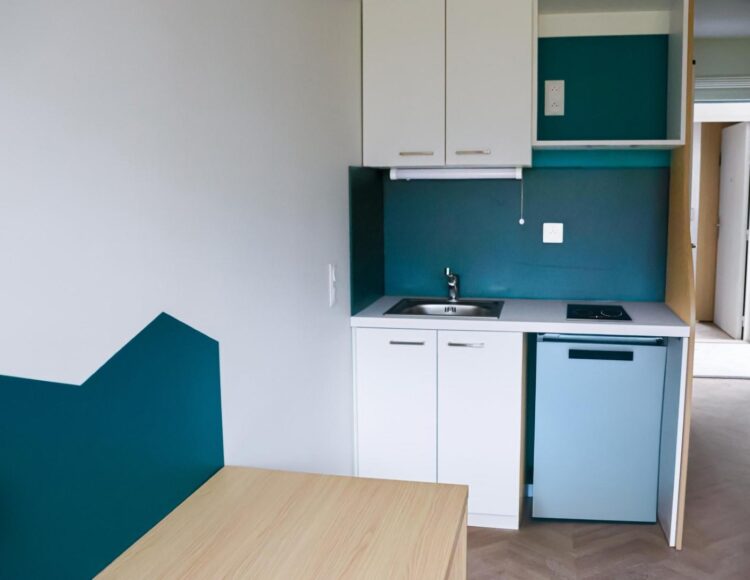
One flagship example is the Joséphine Baker student residence in Grenoble. Built and owned by a not-for-profit social housing provider, it combines high environmental performance with student-centred design. It has green roofs, photovoltaic panels, district heating, rainwater harvesting, high summer comfort insulation, and crucially, shared spaces that support wellbeing, from co-working rooms to sports facilities.
Twenty-five homes are fully adapted for students with disabilities, co-designed with specialist teams. This is social housing as infrastructure for equal opportunity.
Public housing authorities as student housing managers in Italy
In Emilia-Romagna, public housing authorities are filling gaps left by the private market. ACER Ferrara, responsible for public and social housing, also manages university residences for a city where half of the 25,000 students are non-resident.
Residences like Corti di Medoro and Putinati offer fully serviced rooms, utilities included, at €270–€429 per month, through agreements with the University of Ferrara and the regional student welfare body ER.GO. Locations are central, well-connected and integrated into the city, not pushed to the periphery.
The model is pragmatic and public ownership, professional management, and formal partnerships with universities to guarantee affordability and access. ACER Reggio Emilia has replicated the approach, extending agreements even to selected private buildings showing how public actors can also shape markets, not just build housing.
Why this matters for EU policy?
The Commission’s Affordable Housing Plan is explicit that students and young people are among the groups most exposed to the housing crisis. EU-SILC data show that 42 percent of young people at risk of poverty spend over 40 percent of their income on housing. That is a structural barrier to education and social mobility.
The Commission insists on mobilising InvestEU, cohesion funds, Erasmus+ pilots and innovative housing models, including co-living and intergenerational schemes. Portugal’s PNAES alone already delivers over 18,000 beds with RRF support, proving the approach works when funding rules align with public delivery.
Quality student housing requires long-term public vision, secure financing, land access, and partnerships between housing providers, universities and social services. As the EU looks to scale up affordable housing, student residences may well be the most convincing proof point. Not because students are a special case but because when public and social housing works for them, it can work for everyone else, too.
Find more best practices in Housing Europe’s Observatory briefing, Housing the EU Youth.