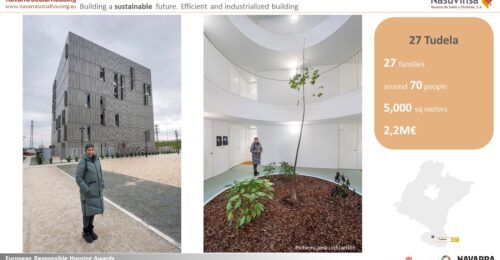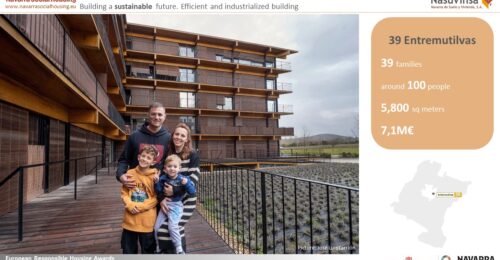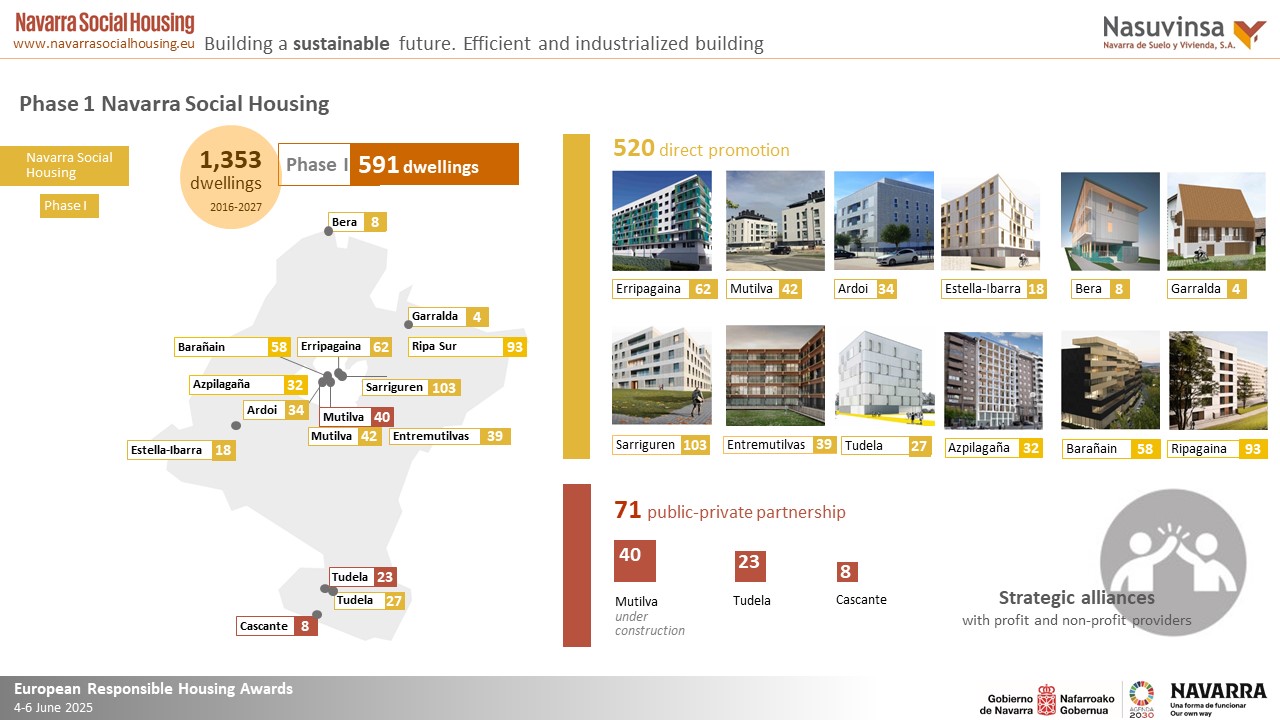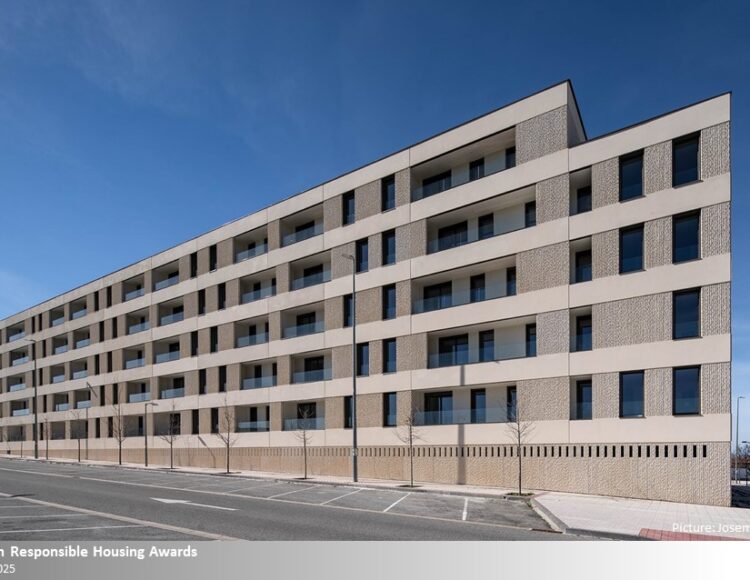
This project was a finalist in the European Responsible Housing Awards 2025 under the ‘Agents of fair energy transition’, organised by Housing Europe, the International Union of Tenants and DELPHIS.
Organisation: Navarra de Suelo y Vivienda, SAU – Nasuvinsa
Goals
The Navarra Social Housing Plan – Phase 1 was launched to address the growing demand for social rental housing in the region, particularly among youth, the elderly, and people with disabilities. The objective was to expand the public housing stock while shifting away from outdated, inefficient models of construction and ownership. Key goals included:
- Eradicating energy poverty and improving indoor environmental quality
- Promoting social inclusion and accessibility for vulnerable groups
- Using sustainable, industrialised construction methods to reduce carbon impact
- Prioritising nearly zero energy buildings (nZEB) through the Passivhaus standard
- Encouraging innovation in materials, construction techniques, and energy management
- Contributing to territorial rebalancing by promoting timber-based construction in rural areas
- Aligning with the Sustainable Development Goals and the European Green Deal
The project aimed to transform public housing delivery through technological and institutional innovation while ensuring that affordability, resilience, and climate responsibility were central to every phase.
Context
Navarre, a foral community in northern Spain, has a population of just over 600,000 and one of the highest R&D expenditures per capita in the country. The region has autonomous authority over housing policy and used this independence to respond to shifting housing demands after the 2008 economic crisis. Public efforts had previously focused on homeownership, leaving a gap in the rental market. Existing housing stock showed significant deficiencies in energy performance, often leading to issues like conde…
In parallel, EU-level energy efficiency directives were advancing, though Spain had not yet transposed the concept of Nearly Zero Energy Buildings (nZEB) into national law. Nasuvinsa—Navarre’s public housing body—chose to proactively adopt the Passivhaus standard for 520 units planned in Phase 1. At the same time, labour shortages and limited technical capacity in the construction sector made innovation a necessity, not a luxury.
What is innovative about this project?
The Navarra plan was the first large-scale public housing initiative in Spain to embrace the Passivhaus standard for energy efficiency, achieving certification in 13 of 16 buildings. The plan incorporated cross-laminated timber (CLT) as a structural material in four buildings, drastically reducing the embedded carbon footprint and encouraging the growth of sustainable forestry-related industries in rural areas.
Construction was guided by industrialised methods, including offsite fabrication and digital coordination. Nasuvinsa treated buildings as “material banks,” framing construction within a circular economy model. Smart buildings were developed with a custom energy management platform that monitored indoor CO₂, humidity, and temperature to ensure performance and comfort. The shift toward industrialisation also helped re-skill the local workforce and modernise traditional construction approaches.
Institutionally, Nasuvinsa pioneered new governance and delivery models. Collaboration between public administrations, social service providers, and local governments was embedded from the early stages, ensuring housing typologies and sites aligned with documented social needs.
Interventions
All tenders—both architectural and construction—were published on the ‘PLENA’ public procurement platform, ensuring full transparency and accessibility. ‘BIM (Building Information Modelling)’ was used in selected developments to enhance coordination and long-term maintenance. On construction sites, the ‘Last Planner® System’ was applied to improve workflow efficiency and team accountability.
Performance was validated through ‘blower door test’ to ensure airtightness and through the deployment of Nasuvinsa’s proprietary monitoring platform for real-time energy and comfort data. The project was co-financed by the ‘European Investment Bank (EIB)’, the ‘Government of Navarre’, and ‘Next Generation EU’ funds through Spain’s Recovery, Transformation and Resilience Plan.
Tenants were selected through the region’s centralised housing registry and received guided tours and training to ensure correct use of the energy systems, reinforcing the programme’s social mission.
Impact
- Constructed 591 dwellings across 16 buildings, housing approximately 1,300 residents
- 13 buildings certified under the Passivhaus standard, with nZEB performance
- 4 buildings built with CLT (Cross-Laminated Timber), promoting sustainable forestry
- €135.7 million mobilised from public and European sources (EIB, NextGen EU)
- Created 300+ jobs in construction, design, and building innovation
- Developed and deployed a **custom smart monitoring platform** for energy management
- Used industrialised offsite construction, reducing time, cost, and waste
- Embedded projects in local needs via municipal collaboration and social services
- Contributed to SDGs and the European Green Deal through circularity and carbon reduction
Lessons learned
- The jury valued the strong integration of sustainability, affordability, and inclusive design.
- The project stands out for its use of renewable energy, circular construction methods, and smart energy monitoring.
- Clear cost structures, public-private collaboration, and job creation make it a replicable and forward-thinking housing model.