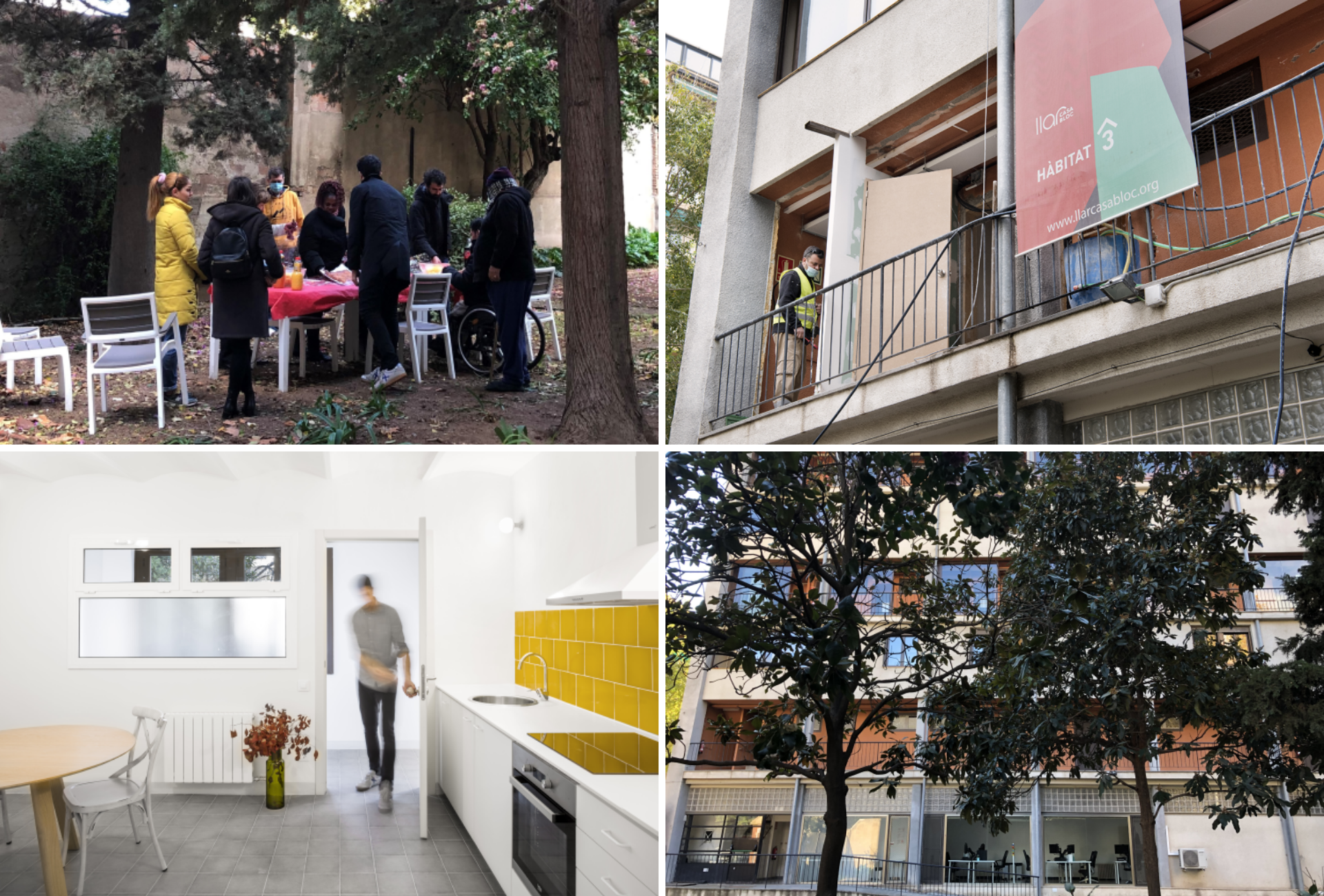
This project was a finalist in the European Responsible Housing Awards 2022 under the ‘Building strategic alliances, fostering community participation’, organised by Housing Europe, the International Union of Tenants and DELPHIS.
Organisation: Fundació Hàbitat3 Tercer Sector Social and City of Barcelona
Goals
Fundació Hàbitat3 mission is to work with other social organisations and public administrations to guarantee the right of decent housing to people in situations of vulnerability.
Llar Casa Bloc Homes for inclusion main objectives are:
- To extend and promote a model of public, social and private collaboration to provide social and inclusion housing and to foster alliances with partners with common aims.
- To rehabilitate a vacant building, in this case, a former nursing home and obtain 17 homes for 26-29 people at risk of exclusion, to assess their specific needs and to provide them with support to develop autonomous living.
- To favour social mix,social cohesion and to foster social inclusion through housing and support.
- To ensure a fair and transparent allocation of the resulting homes to social organizsations that need housing for their projects of inclusion and to public social housing programmes.
- To promote social awareness of the need for social housing and the opportunities for development through the rehabilitation of a 1930s rationalist building with both architectural and social relevance.
Context
Barcelona is a vibrant and attractive city and a very expensive real estate market, over 40% of home renters devote over 40% of their income to housing; accessing a decent and affordable home becomes a struggle for many citizens, most especially those in situations of social vulnerability and in need of support to develop an autonomous living; compared to other European cities, the social housing park is very low and does not meet the existing needs.
In this context Fundació Hàbitat3 is promoted within the social sector to become a social housing operator that provides and manages housing by buying and leasing homes, rehabilitating them together with social enterprises, making them available to other social organizations and public housing programmes and granting support to the tenants either through the social organisations themselves or its own social support team.
In 2015 Fundació Hàbitat3 started Sant Eloi, a project based on a 32-apartment building in Barcelona leased by the Catalan Agency of Housing. Working in partnership with 9 social organizations it has become the home to 44 people, from different vulnerable backgrounds.
The rehabilitation of Llar Casa Bloc is a new step within this housing for inclusion model and also brings in private partners that help finance the rehabilitation costs and contribute technological and sustainability expertise. As a result, 17 new homes are available for 26 people in various situations of vulnerability, women victims of violence, people with mental or physical disabilities, homeless or evicted from their homes and they have specialised support.
Fundació Hàbitat3 conducts the rehabilitation of the former nursing home in Casa Bloc and promotes a social housing project in Barcelona. Two floors of the building have been so far transformed and adapted to the new housing needs of people assisted by social organisations and also for people cared for by Barcelona city council social services. Tenants were able to move into the apartments in February 2021.
Casa Bloc complex of five buildings was designed by the architects Sert, Torres Clavé i Subirana, from the prestigious group GATPAC, it ruptured the current conceptions of social housing building and became one of the best examples of rationalist architecture of the 20th century. An architectural competition was conducted in collaboration with Col·legi d’Arquitectes de Catalunya, the professional association of architects and from the 38 projects submitted and “Desbloc” by Estudi Fabric won the competition.
The renovation to obtain the new homes has been conducted with measures to tackle the digital gap and various monitoring systems. To address energy poverty and the environmental impact,‘A’ class boilers have been installed.. The project has been supported by the Catalan Government through the Catalan Agency of Housing and the Department of social affairs and families and Barcelona City Council.
What is innovative about this project?
The successful integration of public policy, architecture and building, housing for people with special needs, property management, private CSR, energy efficiency and sustainability and social awareness by bringing together a number of key partners who have contributed with their specific expertise, to develop a model of vacant buildings renovation and transformation to address the new range of housing needs of people who are in the most vulnerable position inour society.
The use of technology and telecommunication expertise, the implementation of energy and water-saving materials and appliances to tackle the digital gap and energy poverty.
The coordinated work of various social organisations that come together in a Governance Board to take part in the common aspects of the building management and exchange knowledge and expertise to better address the residents’ needs of assistance and support.
There are very few not-for-profit housing organisations in Spain that provide rental homes and even less that address the needs of people at risk of exclusion. Fundació Hàbitat3 stands as one of the largest, both in number of homes managed and people housed and also as one of the very few that combines housing provision, rehabilitation, management, maintenance and social support.
Interventions
Networking and trust-building amongst a wide range of partners have been key to navigating a challenging project and setting, monitoring progress and achieving the common goal.
Planning, monitoring and budgeting tools for the development and implementation of the renovation project.
Governance Board with the social organisations to take part in the common aspects of the building management and as a forum to exchange knowledge and expertise to better address the residents’ needs of assistance and support.
Monitoring of energy usage and living comfort concerning humidity and temperature with sensors in the apartment. Residents and support teams can get their data on a platform accessible from tablets located at each home.
Training tenants to gather and use data collected to reduce energy usage and cost.
Monitoring of electricity production and the efficiency of the solar panel to be installed on the roof of the building that will provide not only for Llar Casa Bloc residents but for the whole building.
Exchange and cooperation with local welfare and cultural organisations to foster community involvement of tenants and favourable perception of the project.
Communication and media management, using the relevance of rehabilitating Llar Casa Bloc to raise awareness for the need for social and inclusion housing and to engage partners from the private sector.
Impact
The project has sought and accomplished to obtain 17 new homes for 26 people with special housing needs through the rehabilitation of two floors in one of the five buildings of Casa Bloc. Energy efficiency criteria and materials have been applied to reduce both environmental impact and energy poverty. The new homes have digital access to address the digital gap and monitoring systems to trace comfort and utilities consumption.
Five social organisations, local and regional administrations and various private partners have come together to address and work out solutions to the social, urbanistic, constructive, sustainability and financial challenges involved in the project.
Residents have the support from social organisations to ensure they can carry on their own in their homes and develop a more autonomous life. A governance body has been established to ensure coordination among the social organisations, the support teams and the residents, to agree on convivial issues and the use of common spaces , as well as to work together to improve assistance and support models.
From their previous situations of homelessness, inadequate or unsafe housing and eviction, there is an evident improvement in the residents’ situation. In the course of 2021, an assessment of specific indicators to measure the improvement of the quality of life of the residents has been conduction.
Lessons learned
- Project aimed at empowering the tenants, especially the most vulnerable ones creating a safe place to help them build up a self-determined life.
- Interesting approach to reuse of a former nursing home in close cooperation with social organisations. A very holistic and supporting framework for the residents.
- Good solutions to combine environmental and social sustainability, empowering tenants to gain control of their energy expenses.