This project was a finalist in the European Responsible Housing Awards 2022 under the ‘Going the extra mile in extraordinary circumstances’, organised by Housing Europe, the International Union of Tenants and DELPHIS.
Organisation: Fondazione Housing Sociale
Goals
The digital version of the Community Start Up path originated in the midst of the pandemic, with the objective of finding alternative ways to build connections and relations among inhabitants of social housing districts during times of isolation and social distancing.
Throughout the previous years, Fondazione Housing Sociale (FHS) designed, experimented and developed its Community Start Up path with the aim of facilitating encounter and collaboration among residents. The path consisted of a series of meetings and labs in which, with the support of specific instruments and tools, the inhabitants were stimulated to cooperate in order to define together the uses of communal spaces available in the project and to organise activities that could be beneficial for the community of residents and for the neighbourhood as a whole.
As the sudden outbreak of the Covid-19 pandemic started, it became immediately clear to the team that in the context of a global pandemic, which forced us to spend most of our time inside our homes, away from family and friends, having occasions for interaction and collaboration was more crucial than ever. For this reason, we focused on re-imagining the Community Start Up path, adapting some activities when possible and designing new ones to bring the community of inhabitants together even during times of social distancing.
Context
The Community Start Up path is proposed by FHS to the residents of its social housing projects, located in different Italian cities and regions. When moving into a social housing complex, residents are offered not only an apartment at an affordable price, but also the opportunity to use a series of communal spaces and to take part in the construction of activities and services collectively designed by the community of inhabitants.
For this to happen, they are invited to a series of meetings and laboratories that constitute the Community Start Up. The Community Start Up path that we propose to residents aims at enabling them to cooperate in order to define together the uses of communal spaces available in the project, the rules governing such spaces and the collaborative activities taking place in them.
The path has a duration of approximately a year and a half and is organised around four independent phases: selection, warm-up, planning and start-up. Each phase consists of a series of activities, meetings and labs in which FHS adopts a methodology that facilitates the co-design of collaborative services by residents. In order to do so, they have developed a toolkit made of tutorials, cards, planning and prototyping instruments.
With the outbreak of the Covid-19 pandemic, FHS looked for alternative ways to continue the Start Up paths that were already going on. As this meant creating an online version of the path, the challenges faced by our team were manifold. Transferring all the meetings online meant giving up on the conviviality of in-person gatherings, which usually consisted of a laboratory followed by a collective meal. Additionally, going online meant communicating with residents from afar and through technological devices, which made it difficult for some categories of inhabitants to join, especially in the beginning. For example, older residents struggled with joining the meetings as they had had scarce familiarity with computers or phones. Therefore, one of the goals we kept in mind while designing the digital Community Start Up path was the necessity to allow all the residents to join the meeting and take active part in them.
So far, the digital Community Start Up has been tested and implemented in five new social housing complexes in Milano, housing more than 2000 inhabitants. In the five projects, the first three phases of the path – selection, warm up and planning – took place between 2020 and 2021.
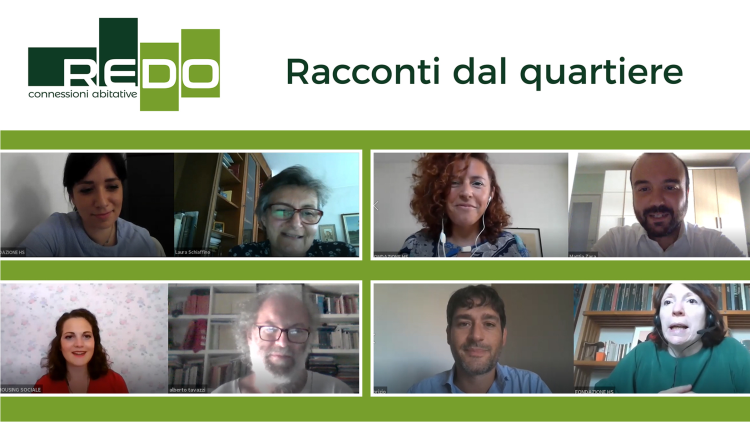
Through a series of online meetings, the residents got to know each other and started sharing ideas and experiences. This led to the creation of thematic working groups, which got together with the objective of planning activities and services that could benefit their daily lives and those of their neighbours too. As a result, some of the first collaborative activities were implemented: from fitness to gardening groups, from activities dedicated to the children to the creation of a set of rules allowing all the residents to use the communal spaces available in the project in complete safety and in accordance with Covid-19 regulations.
What is innovative about this project?
The Community Start Up path is deeply innovative, as it allows us to go beyond the simple provision of affordable homes. The path generates social impact and contributes to building a strong network of local relations.
Building on this, the digital version of the Community Start Up introduces additional levels of innovation. To begin with, it adopts digital tools and platforms that make it possible for people to work together in small groups, sharing ideas and designing activities according to their common interests. Additionally, the online path can be seen as more inclusive, as the possibility to join from home makes it easier and less time consuming to participate. By bringing elderly residents online with the help of FHS’s technical assistance, the meetings also contribute to tackling the digital gap.
The path is designed to be replicable and throughout the years it was already implemented in different projects, both in its physical and online versions. FHS’s methodology offers a toolkit (tutorials, cards, design and prototyping frameworks) and a neighbourhood App, developed in collaboration with Planet App. This allows to optimise resources and time when designing and implementing activities. In the coming years, a hybrid version of the path will be experimented, combining online and in-person meeting.
Interventions
The phases and the activities that make up the Community Start Up path are summarised in the Road Map. Following the outbreak of the Covid-19 pandemic, most of the activities and tools were re-designed to go on with the path even in the context of social distancing. The new online tools can be replicated and adapted to different contexts. Here are some of the instruments and activities designed and tested in 2020/2021:
- Online Staking Plan on Miro Whiteboard: a first step in getting to know the neighbours. The Stacking Plan is a simplified representation of the social housing complex, allowing the residents to visualise all the buildings and floors and to match the different apartments with their inhabitants through a game and with the support of neighbour identity cards.
- Video interviews with local stakeholders: a storytelling initiative to welcome the residents in their new neighbourhood through the stories and voices of local actors.
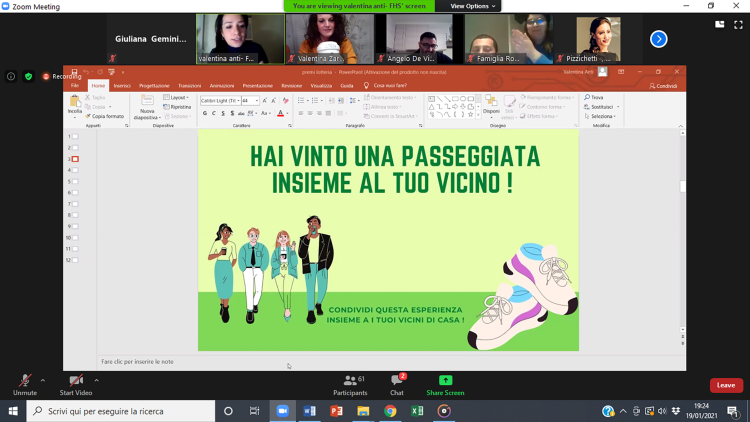
- The Good Neighbour Lottery: an occasion for encounter and collaboration among residents. Through a lottery, each participant is matched to a simple social activity and to a group of neighbours to complete it with.
- Google Jamboard or Miro Whiteboard with a set of Digital Social Cards, used to develop and sum up the collaborative activities imagined by residents during the laboratory “Planning Future Activities”. The digital social cards (taken from a previously existing set) provide examples of collaborative activities that could inspire the residents.
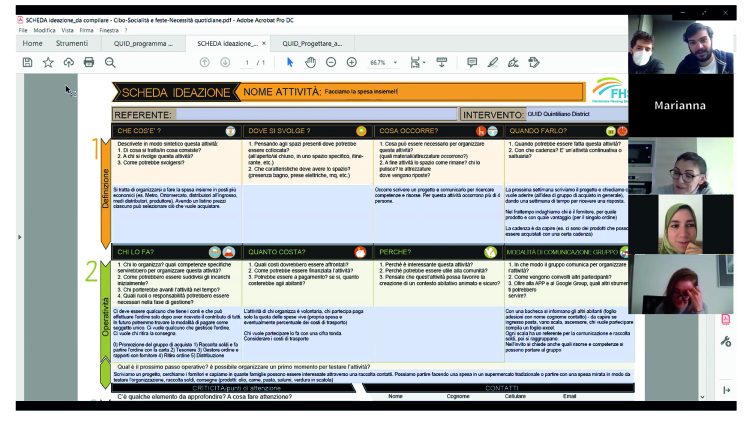
- Design Framework, an instrument helping the residents transform their ideas into concrete collaborative activities.
- Communal Spaces Checklist, a tool designed with the residents, establishing the rules for safe use of the communal areas located in the projects.
Impact
In the past few years, FHS developed an evaluation framework with the objective of assessing the social impact of its projects, with a focus on the effects of the Community Start Up path. Even if data on the impact of the digital Start Up will be available only in the coming years, it is possible to already assess many of its key results.
To begin with, the online path provided the residents of new social housing projects with occasions to meet and get to know each other, which in the context of isolation and social distancing brought about by the pandemic was of crucial importance. Through the online meetings, the inhabitants were able to share their experiences, give each other advices and support and collectively design collaborative activities that could be implemented even in Covid times. In the different social housing projects, groups of residents got together and organised activities of micro sociability and conviviality, exchange and mutual help.
One key benefit of the digital Start Up was the possibility to involve a broader section of the population, making the path more inclusive. Indeed, many inhabitants who were not able to participate to in-person meetings (i.e. families with kids, people working in the evenings or during the weekend), found the online meetings easier to access from home and less time consuming, and were therefore more involved in the path. Furthermore, the technical assistance set up by FHS for online meetings made it possible for everyone to join the labs, avoiding the exclusion of certain categories that could struggle with digital devices, such as the elderly population. In this way, the Start Up also contributed to the community’s digitalisation.
Lessons learned
- Neighbourhood association build through innovative digital tools such as a neighbourhood app
- Facilitation neighbours to get to know each other, creating a community-building approach, providing spaces and occasions to meet.
- Bringing the community of inhabitants together even during times of social distancing.