
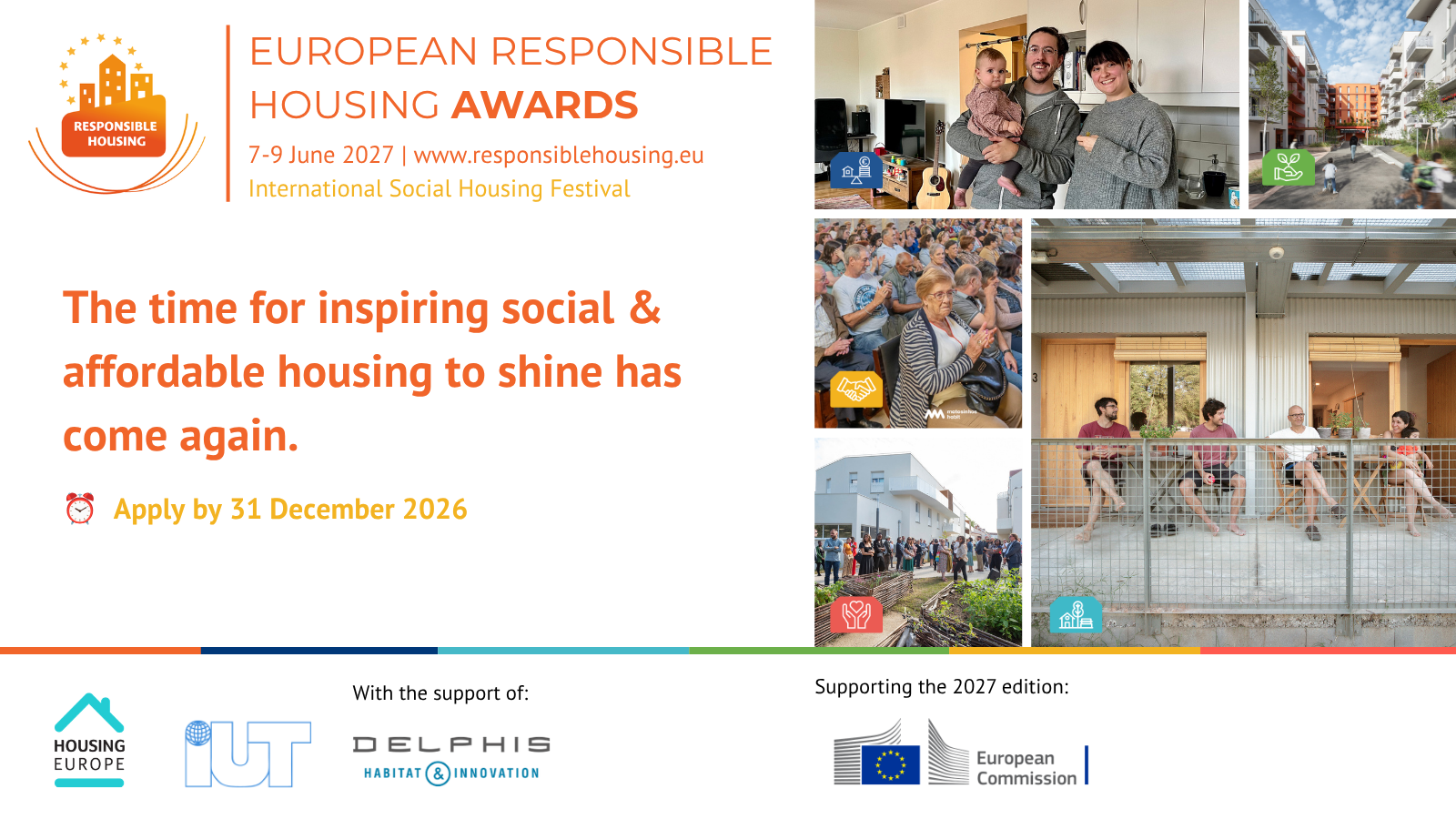
From Brussels and Lyon to Helsinki, Barcelona, Dublin and now Lisbon: the European Responsible Housing Awards return for their sixth edition on 7–9 June 2027.
Organised by Housing Europe, the International Union for Tenants and DELPHIS, and this time with the support of the European Commission, the Awards will be presented during the International Social Housing Festival in Lisbon. The Festival brings together social and affordable housing providers, policymakers, tenant representatives, urbanists, architects, researchers, journalists and activists from around the world. For 2027, more than 3,000 delegates are expected.
Responsible housing is often built through decisions that may seem obvious: cutting the time and cost needed to deliver affordable homes; making a building fossil-free without making it unaffordable; or giving residents a real role in the everyday management of their neighbourhood.
Yet these choices can make a profound difference.
Previous Award-winning projects show what this looks like in practice. In Stockholm, a shared approach to planning and procurement has helped speed up the delivery of affordable rental homes. In Vienna, Wientalterrasse combines fossil-free energy, affordable rents and spaces that support intergenerational life. In Matosinhos, elected resident representatives help improve communication, shared responsibility and trust within municipal housing estates.
The 2027 Awards are looking for projects that turn such commitments into measurable change: projects that make housing more affordable, sustainable, inclusive, democratic and resilient.
The categories
Fair Financing for Housing Affordability and Economic Responsibility
- Invest sustainably, ensuring cost-effectiveness and balancing the level of services provided, the related costs and how far current and prospective tenants/residents can afford them, thus minimizing housing costs.
- Together with tenants/residents, endeavour to ensure that innovative energy saving measures improve the affordability of total housing costs, including energy costs, and the comfort of dwellings.
- Invest in affordable housing on the long-term, contributing to more stable housing markets, thereby mitigating the negative effects of real estate speculation.
- Support responsible procurement practices and local economic growth and employment through partnerships, research, knowledge sharing, capacity building and innovation.
- Implement innovative and scalable financing models at an organisational, regional or national level that support the long-term provision and renovation of affordable housing, including revolving funds, guarantee schemes and other mechanisms that mobilise investment while preserving affordability.
”More than a roof” – Local Social sustainability for communities
- Ensure decent, accessible housing is available at an affordable cost, and will remain so in the future.
- Manage the housing stock so that homes are well maintained adapted to changing demographic needs, with repairs and improvements carried out when required, involving tenants/residents in the decision process.
- Ensure security of tenure based on fair and safe tenancy agreements, and work with partners to help residents, particularly vulnerable groups, access the support they need to stay in their homes.
- Make sure to meet the diversity of households’ needs, including those of the most vulnerable and persons with disabilities, through accessible and inclusive housing solutions, treat fairly each current and prospective tenant/resident, and prevent all forms of discrimination.
- Work together with local authorities and other stakeholders to guarantee fair access to housing and related services, and that housing allocation increases social mix.
- Work together with local authorities and other stakeholders at local level to promote innovative, socially cohesive and inclusive neighbourhoods, and fight social and spatial segregation.
Leaders of Innovation for a Fair Energy Transition
- Reduce the environmental footprint of our housing stock through construction, retrofitting and the transformation of existing buildings, to the highest standard possible, in a cost-effective way for both providers and tenants/residents.
- Cooperate with tenants/residents and their representative organisations to reduce energy consumption in our buildings and reduce energy poverty, to prevent pollution and promote a sustainable use of natural resources.
- Include green infrastructures, nature-based solutions and common green spaces in our estates and build partnerships with other organisations to create environmentally sustainable and resilient neighbourhoods.
- Promote climate change mitigation and adaptation through resilient buildings, neighbourhoods and infrastructure that can respond to changing environmental conditions.
- Deploy innovative and resource-efficient construction, renovation and management solutions, including industrialised construction methods, circular approaches, digital tools, artificial intelligence and other emerging technologies, while strengthening the skills and capacities needed to deliver sustainable and climate-resilient housing.
Building Strategic Alliances and Fostering Community Participation
- Ensure good communication and transparency on how and why decisions are taken, as well as on expenses and services provided.
- Work in partnership with local authorities so that those who are looking for a home are aware and well informed on available possibilities, and handle the allocation process transparently.
- Support greater stakeholders’ engagement and real partnerships, based on mutual commitments and clear roles and responsibilities, and co-creation.
- Strengthen institutional and structured participation of tenants/residents, and facilitate this proces by providing them with the necessary knowledge and information and capacity-building opportunities.
- Ensure accountability towards the different stakeholders and opportunities for feedback, joint learning, and evaluation and assessment of the activities carried out, as well their impact.
The 2027 edition includes a special prize.
Going the Extra Mile for Housing the Youth
- Develop innovative, affordable quality and well-located housing for young people, including students, young workers and those entering independent living.
- Promote housing models that combine affordability, sustainability, quality and long-term security of tenure.
- Support housing stability through innovative partnerships, financing mechanisms and housing management approaches.
- Co-management and co-design of young residents in shaping housing services, communities and neighbourhoods.
- Showcase initiatives that contribute to attracting young people by creating inclusive, vibrant and affordable places to live.
- Promote intergenerational living through housing models that strengthen solidarity and mutual support between generations.
Across all categories, the Awards recognise not-for-profit housing providers and their partners that place residents and the public interest at the heart of their work.
Projects are assessed by an independent Jury, in which tenant representatives hold the majority. The Jury will look at how initiatives work in practice: the partnerships behind them; their social, environmental and economic impact; transparency and accountability; the tools and methods used; and their potential to inspire or be adapted elsewhere. Innovation matters, but so does whether it improves people’s homes and lives. The European Responsible Housing Awards offer more than recognition. They bring outstanding projects to a European and international audience, create opportunities to exchange experience with peers, and show that responsible housing is not an aspiration for the future—it is already being delivered across Europe.
Do you have a project that has made a tangible difference to people’s homes or neighbourhoods? Whether it has made housing more affordable, brought residents into decision-making, reduced environmental impact or created stronger local partnerships, we would like to hear about it.
Looking for examples? Make sure to check the 25 finalists back in 2025.
Find all information about the Awards on the official website.
The deadline to apply is December 31, 2026.