The 2025 Eurobarometer reveals that housing is one of the top concerns for Europeans, while companies struggle to find workers, an issue made more acute by high rents. Recent national elections show just how politically vulnerable governments become when housing policies fall short. Meanwhile, the 2040 emission-cutting deadline is fast approaching.
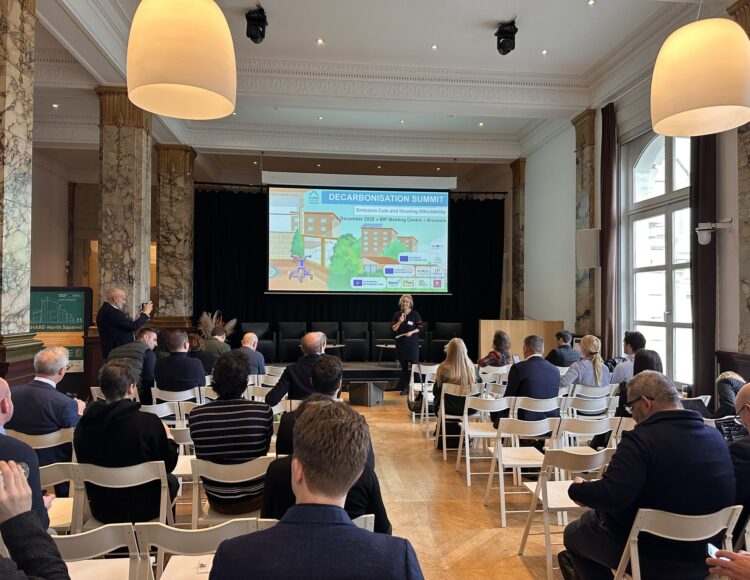
On December 3 and 4, Housing Europe’s Decarbonisation Summit explored different paths to homes that emit less CO2 but also keep liveable neighbourhoods and affordability at the centre. Beyond neighbourhood-scale renovation, pre-fabrication methods and low-carbon new delivery using bio-sourced materials, heat pumps and sustainable mobility, we also highlighted how local energy productionfrom shared renewables to community energy systems—can ease household energy costs and accelerate climate goals. We also examined the conversion of existing buildings as an essential strategy to expand housing supply while reducing the carbon footprint of construction.
The Summit connected practical solutions with the evolving EU policy and financial framework, ahead of the launch of the Affordable Housing Plan, the deadline for the re-allocation of Cohesion Funds for Housing, the roll-out of the Social Climate Fund (SCF), and the implementation of the revised Energy Performance of Buildings Directive (EPBD).
Decarbonising the housing stock for a fair energy transition\
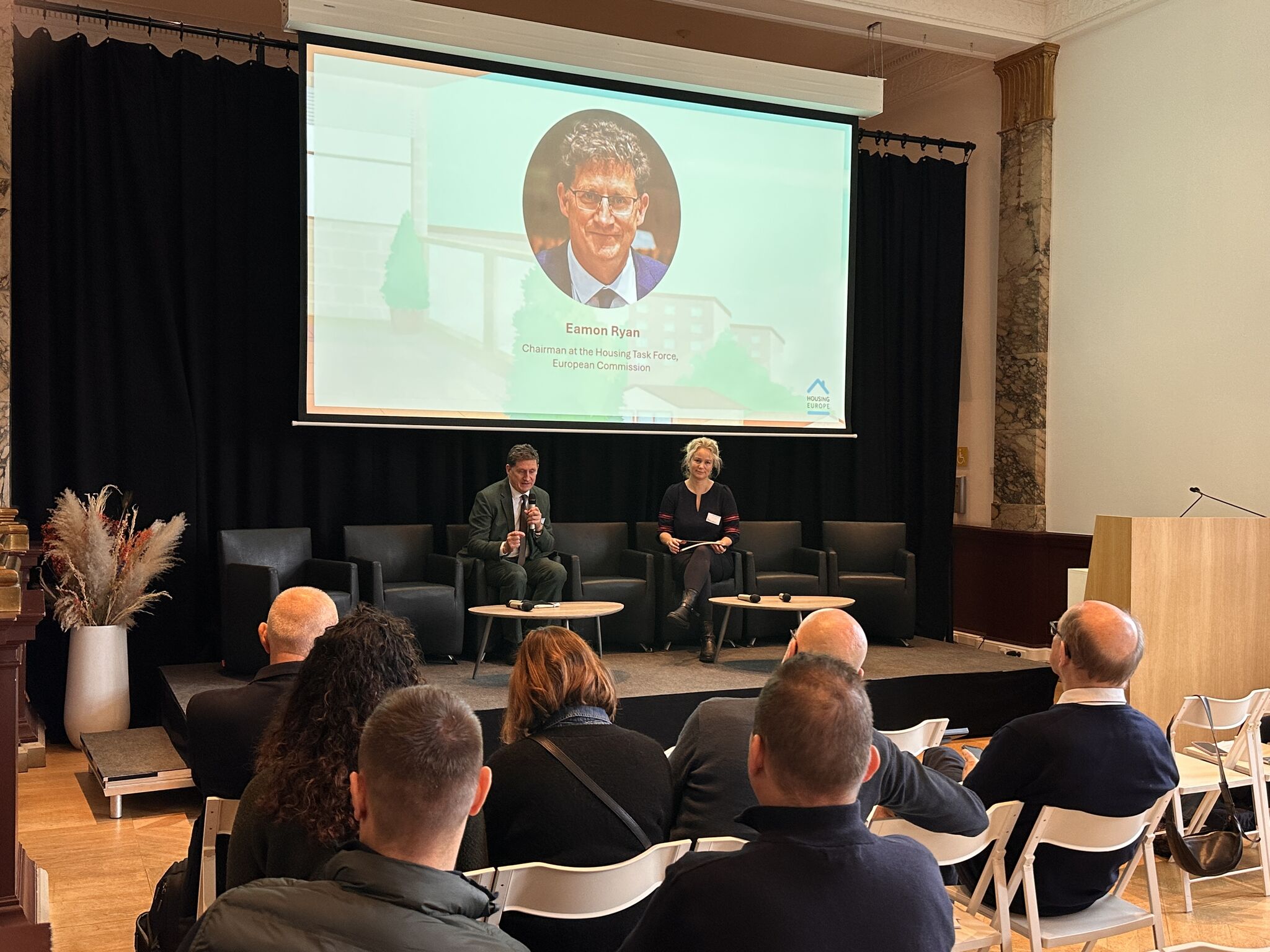
When Marco Corradi opened Housing Europe’s Decarbonisation Summit in Brussels, he framed the discussion asking whether Europe can cut emissions from homes fast enough without pushing people further into a housing crisis? Over two days, alongside Eamon Ryan, Chair of the Advisory Board of the European Commission’s Housing Task Force, and dozens of practitioners, the answer that emerged was yes, but only if climate policy is designed as an investment in affordable homes and neighbourhoods, not as a parallel agenda.
The Summit took place just days before the European Affordable Housing Plan is due to be unveiled. That milestone acted was our metronome in the room. Every pilot, business model and policy proposal was weighed against a single test – will this help Europe build and renovate enough affordable homes, at the right cost, for the people who need them most?
Neighbourhoods first: renovation that keeps people at the centre
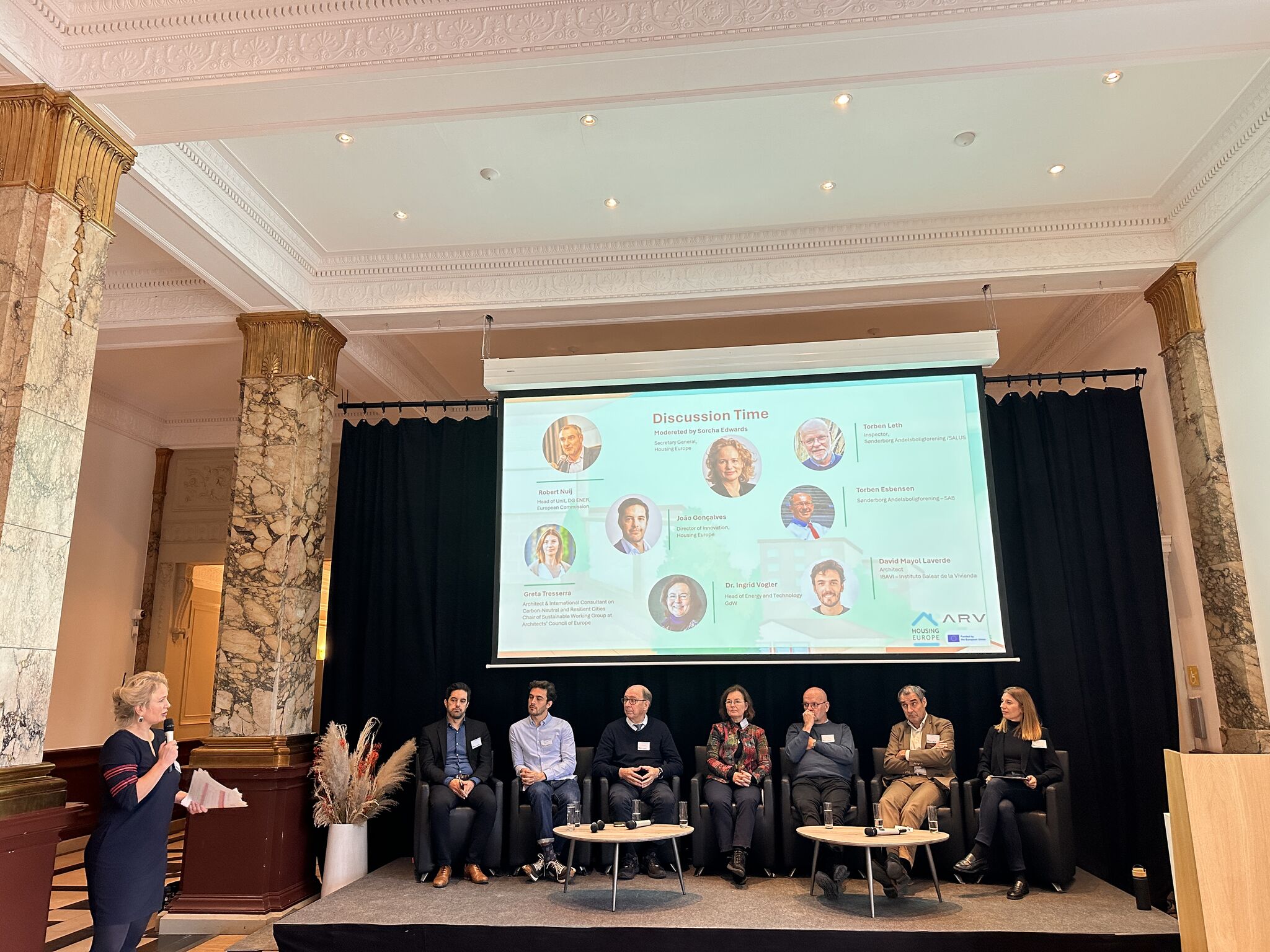
In the opening session on neighbourhood-scale renovation, Robert Nuij from DG ENER reminded participants that the revised Energy Performance of Buildings Directive gives Member States a solid framework but that turning directives into lived reality will happen street by street, block by block.
From there, João Gonçalves, our Director of Innovation at Housing Europe, set out what the Affordable Housing Initiative European Partnership is already doing on the ground: stitching together climate-neutral districts where renovation, new construction, local energy production and social support are designed as one package rather than as separate projects.
Speakers brought those ideas to life through very different contexts. Ingrid Vogler from GdW showed how German cooperatives use a neighbourhood approach to make the numbers add up by phasing works, combining building envelopes with energy communities, and always testing whether rent levels remain affordable over time. David Mayol, from IBAVI in the Balearic Islands, spoke about designing with the climate rather than against it, using local materials and natural ventilation to keep homes both cool and affordable.
From Sønderborg in Denmark, Torben Esbensen and Torben Leth described what “fair renovation” looks like when tenants are deeply involved: careful sequencing to avoid displacement, transparent communication on costs and savings, and governance models where residents are not just informed, but empowered. Architect Greta Tresserra then zoomed back out to the European level, showing how EPBD, New European Bauhaus and energy-transition tools can reinforce each other when applied at neighbourhood scale, rather than as isolated compliance exercises.
Across these stories, it stood out that decarbonisation becomes politically and socially possible when it improves everyday life in the neighbourhood with better comfort, safer streets, lower bills, more dignified public spaces.
Moving people, not just cars: mobility as housing policy
While one afternoon track focused on buildings, the parallel session on reduced parking for affordable housing asked a more uncomfortable question: how much scarce urban land is still being reserved for cars rather than for homes, trees and shared spaces?
Moderated by Jelten Baguet from MPACT, the session brought mobility and housing worlds into the same room. Constantin Heitzer from DG CLIMA explained how the Social Climate Fund can support low-emission mobility solutions in social and affordable housing, provided Member States are ready to integrate shared mobility into their Social Climate Plans.
Alexander Czeh illustrated how car dependence inflates both emissions and housing costs, especially in peripheral areas, and argued that “the mobility transition is also a housing affordability strategy.” He presented groundbreaking research quantifying the off-street land consumption of car infrastructure in Berlin. Using more than 90,000 GIS shapes, he identified 22 square kilometres of car-related land – car dealerships, private garages, rooftop parking, petrol stations and surface lots – hidden across the city. This area exceeds the size of an entire Berlin district home to 290,000 people, and much of it sits in neighbourhoods where fewer than 10% of trips are made by car. rom Polis showed how some cities are already rewriting parking norms, using shared mobility and better public transport to reduce the number of compulsory parking spots in new developments.
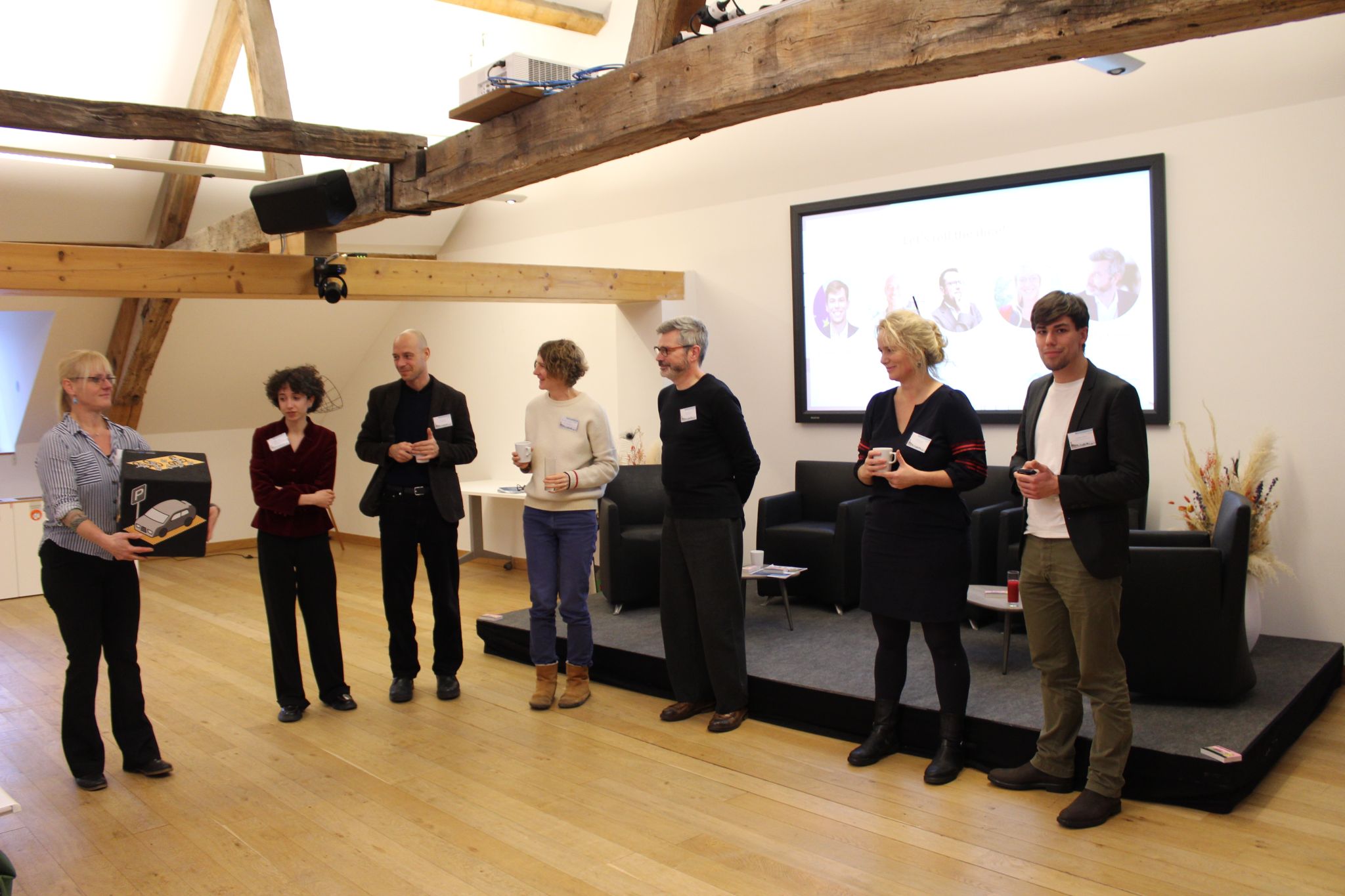
Two case studies made the potential very tangible. Cornelia Cordes presented Bremen’s innovative parking by-laws, which allow social and affordable housing projects to replace a portion of parking requirements with shared mobility services. Gert Eyckmans, Director of the social housing federation, Initia Vlaanderen and member of Housing Europe, described what this means on the ground in Flemish social housing estates: less asphalt, more space for homes and play, and mobility choices that remain affordable for low-income tenants.
The message for EU and national policymakers was that if regulations keep assuming two cars per household, even the best renovation strategies will be fighting an uphill battle. Shared mobility, smart parking rules and social housing policy have to move together.
Wood, beauty and the New European Bauhaus
In the LIFE BE-WoodEN conference, integrated into the Summit, participants shifted focus to embodied carbon. With Andreja Kutnar as master of ceremonies, the session explored how bio-based materials can cut emissions while delivering better architecture for residents.
Housing Europe President, Marco Corradi and JRC’s Elena Montani linked the discussion to the New European Bauhaus: sustainability, inclusion and beauty need to be designed into social housing, not reserved for showcase projects. UNEP’s Jonathan Duwyn underlined that the way we build today will lock in emissions for decades, and that wood can play a decisive role if used responsibly.
Practitioners such as Silvia Melegari (CEI-BOIS & EOS), Sofia Hansdotter (Public Housing Sweden), David Bravo (WikiHousing) and Jacques Timmerman (Architects’ Council of Europe) discussed the very practical barriers that still hold wood back in social housing: diverging fire regulations, lack of skills, fragmented supply chains, and cultural resistance.
The BE-WoodEN partners then showed how targeted training, hands-on pilots and New European Bauhaus-inspired processes, like Liguria’s challenge-based design of common areas for elderly residents, can overcome those barriers. The conclusion was cautiously optimistic. The right skills and rules, bio-based materials can help social and cooperative housing providers decarbonise and offer warmer, more humane spaces.
From factories to districts: prefabrication at scale
The session on prefabricated construction and renovation, introduced by our Policy Director, Julien Dijol, took participants straight into the factory. Using examples from GigaRegioFactory, Build-Up Speed and the BARRIO project, speakers showed how industrialised methods can finally move deep renovation and new construction to the scale required.
Sofia Hansdotter shared how Swedish public housing companies are experimenting with prefabricated façades and modules to deliver predictable quality and minimise disruption for tenants. Giulia De Aloysio from Certimac explained how BARRIO’s demand-aggregation model helps smaller housing providers bundle projects so that industrial partners can invest in production lines with confidence.
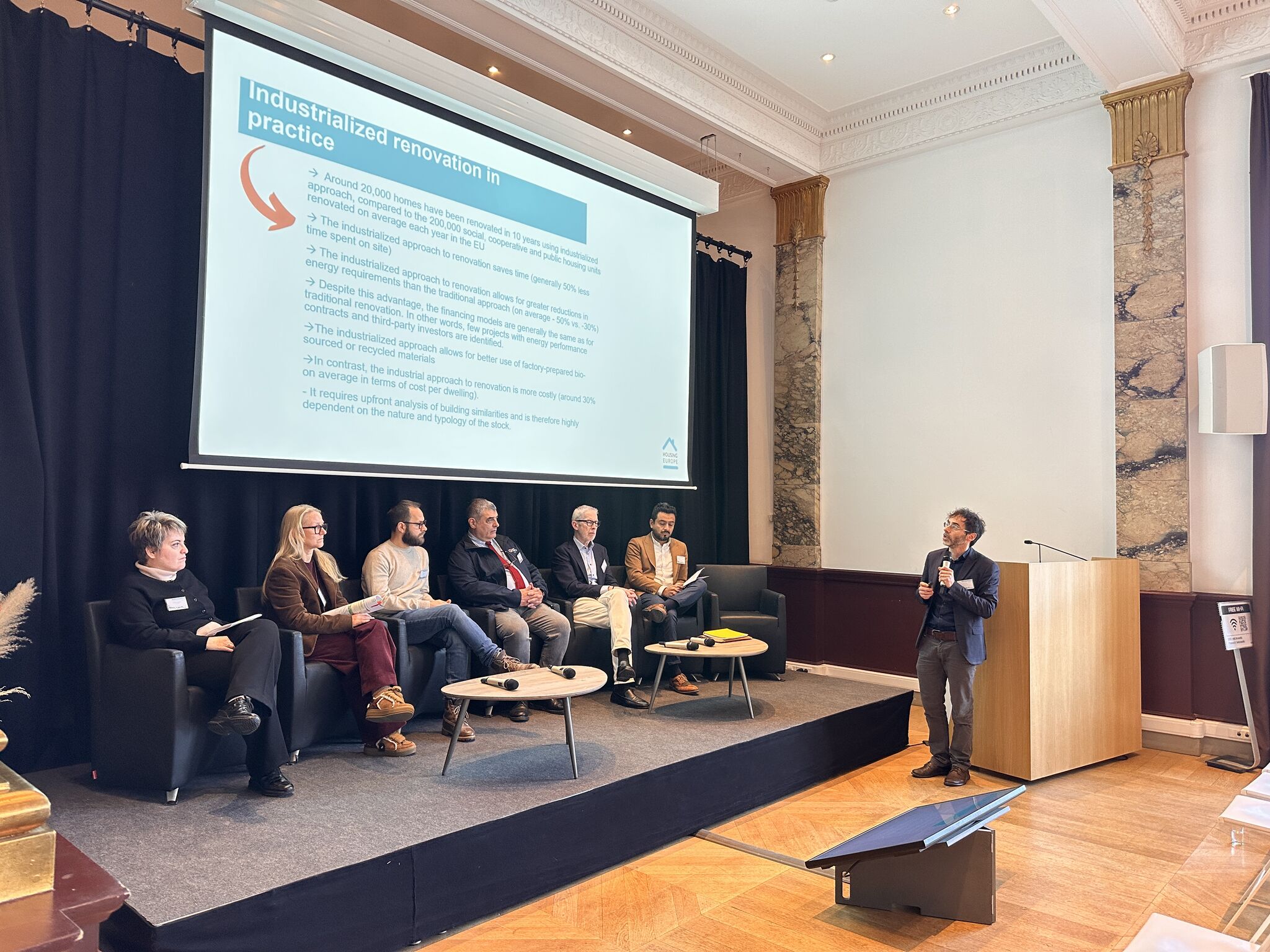
From Italy, Dario Marino presented Edera’s work on open-source design tools and plug-and-play retrofit packages, while Germain Adell from Metabuilding highlighted the role of innovation ecosystems and SMEs in delivering these solutions. Alan Milne of the Modular Building Institute and Fernando Sigchos Jiménez from the European Builders Confederation stressed that industrialised renovation is also an industrial policy as it can create stable local jobs and new skills if the right safeguards and training are in place.
Together, these contributions made a key point: industrialisation is not about “one-size-fits-all boxes”, but about using standardised components to free up time and resources for what truly needs to be tailored, namely social support, resident engagement, and neighbourhood design.
Heat pumps, business models and the cost of comfort
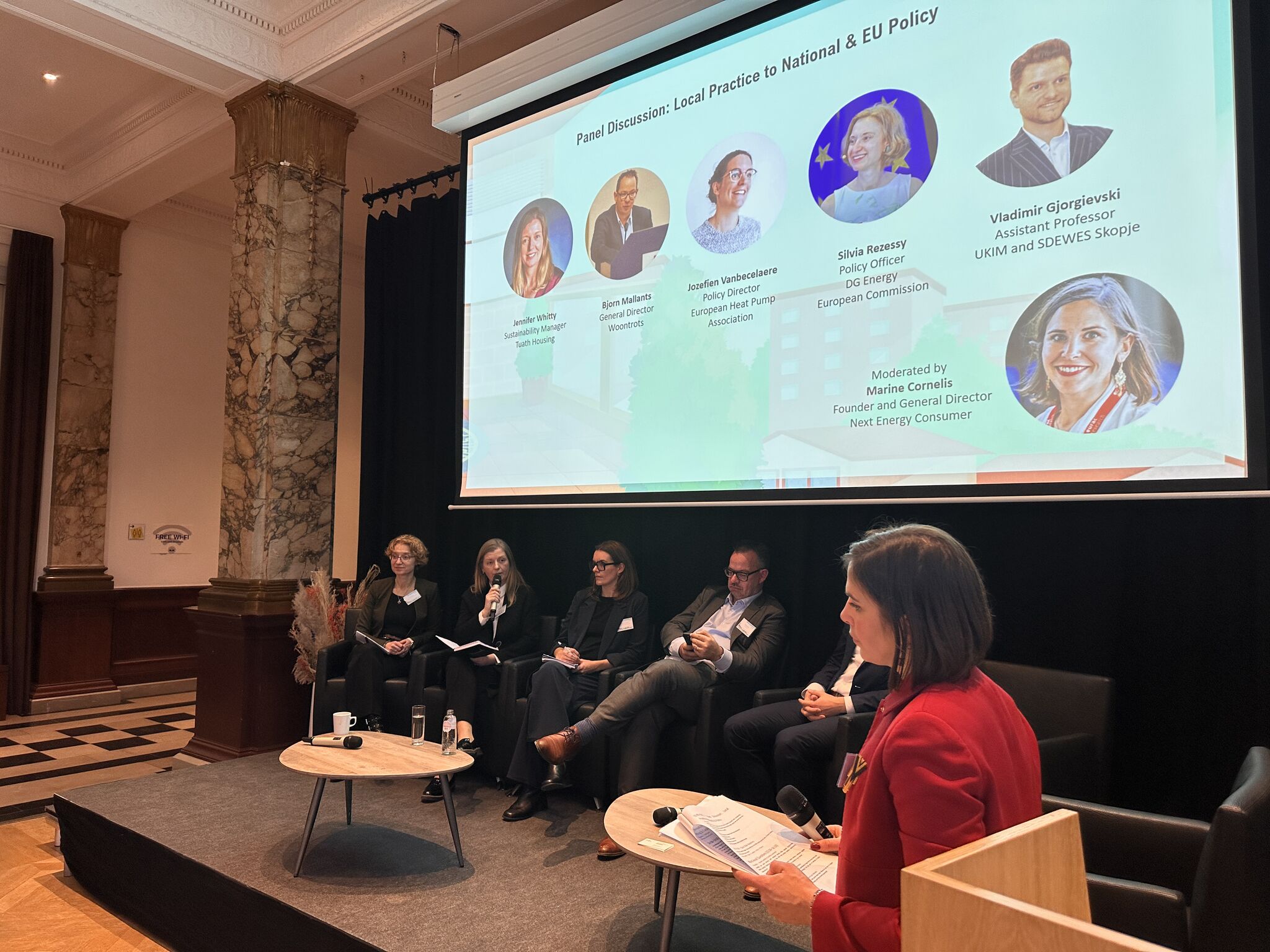
The closing session, moderated by Marine Cornelis, zoomed in on one of the most contested pieces of the transition: heat pumps. With sales falling in several Member States despite ambitious EU targets, the mood was frank.
Silvia Rezessy from DG ENER set the scene: heating and cooling still account for about half of the EU’s energy use, most of it fossil-based, and policy is now in the “implementation decade”. She stressed the need for stable, well-targeted public support, integrated with National Building Renovation Plans and heating and cooling strategies, rather than boom-and-bust subsidy cycles.
Herbert Tretter and Louise Meister from the Austrian Energy Agency then introduced the install.res catalogues of technical solutions and business models, designed to help non-experts choose the right configuration for real buildings and real budgets. That framework came alive through five pilot stories.
Vladimir Gjorgievski showed how, in North Macedonia, energy performance contracting and one-stop-shop models are being tested in a landmark hotel and in residential buildings to overcome high upfront costs and market fragmentation. Patryk Czarnecki presented Sozialbau’s “facade heat pump” retrofits in Vienna, where pipes are integrated into external walls to deliver low-temperature heating and cooling with minimal disruption to tenants.
Suzana Guček from KRONOTERM described how a manufacturer can support social housing providers through remote monitoring and long-term service, while warning about the distorting impact of badly designed subsidies.
From Poland, Piotr Sprzączak explained how Veolia combines district heating optimisation, hybrid substations, photovoltaics and ESCO contracts to decarbonise large multi-apartment buildings. In the Netherlands, Michiel van der Vight showed how De WarmteTransitieMakers’ online comparator helps homeowners and municipalities navigate the maze of technologies and costs, and how similar tools could empower social housing tenants as well.
In the panel that followed, Jozefien Vanbecelaere (European Heat Pump Association), Silvia Rezessy, Vladimir Gjorgievski, and two social housing voices Jennifer Whitty from Tuath Housing and Bjorn Mallants from Woontrots brought the discussion back to residents.
Jennifer spoke candidly about fears, rumours and refusal rates when tenants feel technologies are imposed rather than explained, especially where prepaid meters and higher perceived electricity prices create anxiety. Tuath is investing heavily in one-to-one support, clear educational materials and tenant-led storytelling to turn initial scepticism into trust.
Bjorn underlined the structural pressures facing social landlords: legal limits on rent increases, ageing residents who often do not choose where they move, and the sheer scale of upcoming renovations. For him, split-incentive models and long-term, predictable frameworks are essential so that housing companies can invest without jeopardising affordability, while still having the resources to coach older tenants through new systems, including cooling as summers get hotter.
Their exchanges converged on a simple idea: the “customer journey” for a heat pump is never just technical. It is about reassurance, coaching, trust and the promise that bills will remain manageable.
From pilots to an investment agenda
Throughout the Summit, speakers kept circling back to the same tension that runs through the forthcoming European Affordable Housing Plan. Europe urgently needs more and better homes, and it must decarbonise its buildings at speed. That is not a contradiction if policy chooses to treat public, cooperative and social housing as the backbone of a long-term investment strategy.
Discussions often echoed key messages from the Advisory Board’s recommendations: affordable housing finance should be governed by clear safeguards for long-term affordability and regulated so that homes stay in the public, cooperative and social housing system; fiscal rules and statistical classifications must stop penalising public investment in housing; existing instruments like InvestEU, the Social Climate Fund and national promotional banks can be better used to blend grants, guarantees and loans for projects that lock in affordability; and EU institutions, from DG ECFIN to the ECB, should recognise that stable, affordable housing is a pillar of macroeconomic and financial stability, not a cost to be minimised.
None of the projects showcased in Brussels claimed to have “the” solution. What they offered, together, was something more valuable: proof that when social, public and cooperative housing providers are trusted and supported, they can turn climate targets into better homes, fairer bills and more liveable neighbourhoods.
As our Secretary-General, Sorcha Edwards said in her closing remarks, Europe already has committed local partners, tested tools and a growing evidence base. The next step is for the Affordable Housing Plan and the wider EU financial framework to back them at the scale required so that decarbonisation and affordability move forward, together, from promising pilots to everyday reality.