Business as usual is no longer delivering when it comes to housing in Europe. With the European Affordable Housing Plan now on the table, the question is no longer whether collaborative housing works, but how it can contribute to systemic solutions across Europe.
Speaking at a recent webinar organised by the Network of Cities for Collaborative Housing (NETCO), Housing Europe Secretary General Sorcha Edwards highlighted the growing role of community-led approaches, including housing cooperatives and Community Land Trusts, in delivering affordable, resilient housing.
From the perspective of public, cooperative and social housing providers, the priority is clear: connecting long-established cooperative systems in countries such as Germany, Switzerland or the Nordics with emerging models across Europe. This means combining strong governance, financial credibility and trust with new approaches that respond to today’s affordability pressures and social needs.
At EU level, this comes at a critical moment. A €34.6 billion reallocation under cohesion policy and discussions on the next Multiannual Financial Framework offer a window of opportunity. To unlock impact, funding must be tied to clear affordability outcomes, legislation should be simplified without weakening public objectives, and cities must be enabled to invest, including through a more supportive treatment of housing within public finance rules.
As highlighted by Grzegorz Gajewski from the European Commission’s Housing Task Force, the scale of the challenge is significant, with an estimated €350 billion investment gap. At the same time, collaborative housing actors are increasingly recognised as drivers of systemic change — capable of enabling social and financial innovation and strengthening cooperation between local authorities and communities.
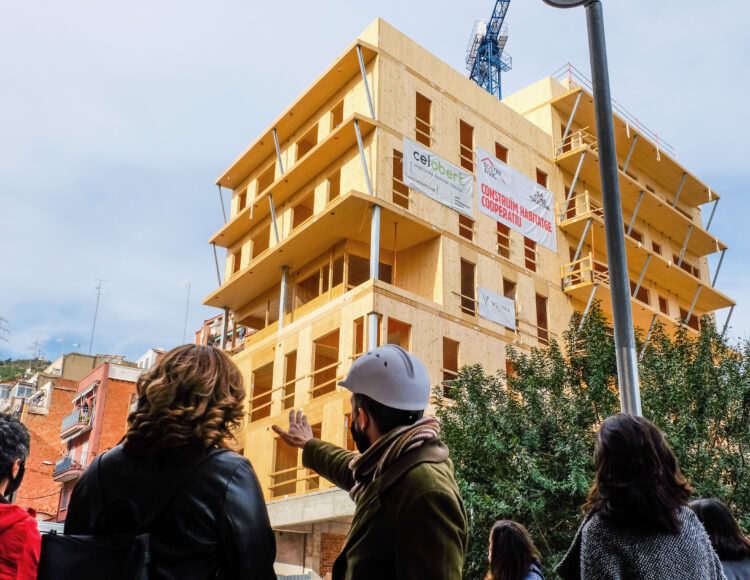
Examples shared during the webinar illustrate how these models are already taking shape across Europe. In Amsterdam, collaborative housing is being scaled within a broader strategy to deliver 7,500 homes per year, supported by public land, municipal tools and a cooperative fund that is now expanding at national level. In Bologna, collaborative housing is embedded in the city’s housing plan, combining affordability with participatory governance and social mix. In Spain, cities such as Manresa are enabling cooperative housing through public land and regulatory adaptation, while in Barcelona Sostre Cívic demonstrates how the model can scale, having secured the largest EU-level loan ever granted to a housing cooperative.
These experiences reflect a broader shift across the sector, also recognised through initiatives such as the European Responsible Housing Awards, where both De Warren in the Netherlands and Sostre Cívic in Spain have been highlighted.
Housing Europe continues to support this momentum through its “Roots & Green Shoots” initiative, which aims to connect emerging practices, strengthen knowledge exchange and support the scaling-up of collaborative housing models across Europe. Organisations interested in contributing are encouraged to get in touch with our colleague Andreea Nacu.
Collaborative housing will not solve the housing crisis on its own, but these examples show it is already part of the answer, and that there is real potential to build on.
Photo credit: Sostre Cívic. Cirerers (Barcelona)