Private fuel-based vehicles are a major source of emissions, pollution and land take in cities, especially in peripheral areas. Meanwhile, public cooperative, and social housing providers face high costs to build parking spaces that are often under-used as well as rigid parking requirements to prioritise homes over cars.
The European Parliament’s report on the housing crisis in the European Union, together with the EPBD transposition by May 2026, notably Article 14 on smart mobility provisions, the Social Climate Fund and the New European Bauhaus, positions sustainable mobility as a lever to reduce household costs and decarbonise living environments.
Addressing mobility is therefore not only a climate concern but a core dimension of housing affordability, decarbonisation and neighbourhood quality, increasingly recognised in EU legislation
If transport and mobility costs are factored into affordability, sustainable mobility becomes a key lever to reduce household expenses. Prioritising walking, cycling, public transport and shared mobility can lower residents’ cost of living, making investment in sustainable mobility a core housing affordability measure, not just a mobility one.
Mandatory parking requirements—often set at one space per dwelling—lock in car dependency and drive up construction costs for housing providers. Underground parking alone can account for up to 20% of total development costs. Relaxing these requirements would free up the financial capacity of housing providers to continue delivering and renovating affordable homes.
Reallocating street space to prioritise walking, cycling and public transport and shared mobility schemes can free up land for green, climate-resilient public space, and even additional housing units. Thus, the mobility transition is itself a housing strategy.
However, major structural barrier remain: car-oriented parking norms, strict building codes. Revisiting these requirements is essential to meeting affordability and decarbonisation objectives.
As part of Housing Europe’s EU-funded Interreg North Sea Region project SHARE-North Squared, the cities of Bremen, Helsingborg, Stavanger, Utrecht, Aarhus and Mechelen are changing their parking bylaws and integrating shared mobility into public, cooperative and social housing.
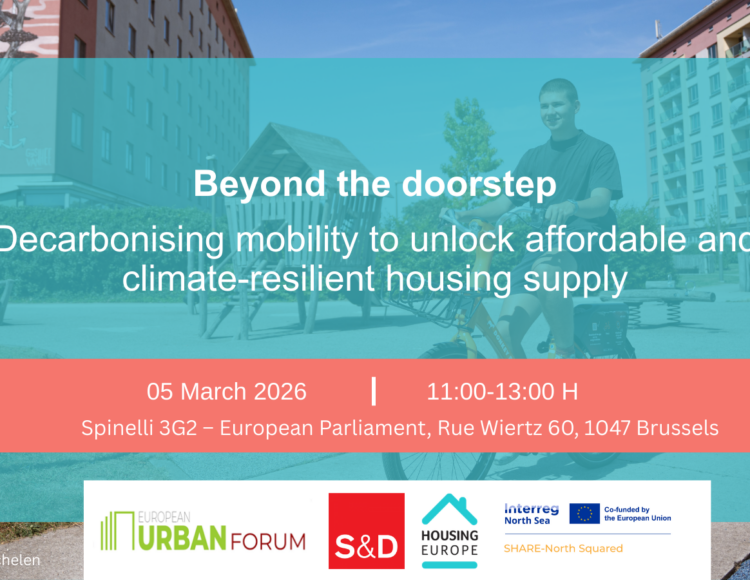
On March 5 (11:00 – 13:00 CET), at the European Parliament (Spinelli 3G2) Housing Europe is organising an event to discuss how the EU can support a new housing paradigm through clever mobility policies. The event is kindly hosted by MEP Marcos Ros Sempere (S&D, Spain) as part of the European Urban Forum
5 March 2026 | 11:00-13:00 CET | European Parliament (Spinelli 3G2)
Welcome address
Marcos Ros Sempere, MEP (S&D, Spain)
Opening remarks
Sorcha Edwards, Secretary-General, Housing Europe
Setting the Scene
The cost of parking for affordable housing
Michael Johansson, Lund University
Innovative Mobility Solutions in Housing
Bremen (Germany)
Cornelia Cordes, Freie Hansestadt Bremen
Kai Manal, GEWOBA public housing company
Mechelen (Belgium)
Ann Vandeurzen, City of Mechelen
Kristof Penders, Woonland Flemish social housing company
Esther De Reys, WayToGo
EU Perspective
Constantin Heitzer, Policy Officer at DG CLIMA (European Commission)
Edit Lakatos and Mariangiola Fabbri, Policy Officers, Housing Task Force (DG ENER, European Commission)
Reactions from Key Stakeholders
Björn Berggren, Energy Expert, Public Housing Sweden
Laurianne Krid, CEO, European Cyclists’ Federation (ECF)
Ivo Cré, Director of Policy, Polis Network
Barbara Steenbergen, Head of International Union of Tenants (IUT) EU Liaison Office
Closing and Recommendations
Julien Dijol, Policy Director, Housing Europe