In a time marked by wars on the continent, rising living costs and growing social tension, housing policy sits at the centre of Europe’s social contract.
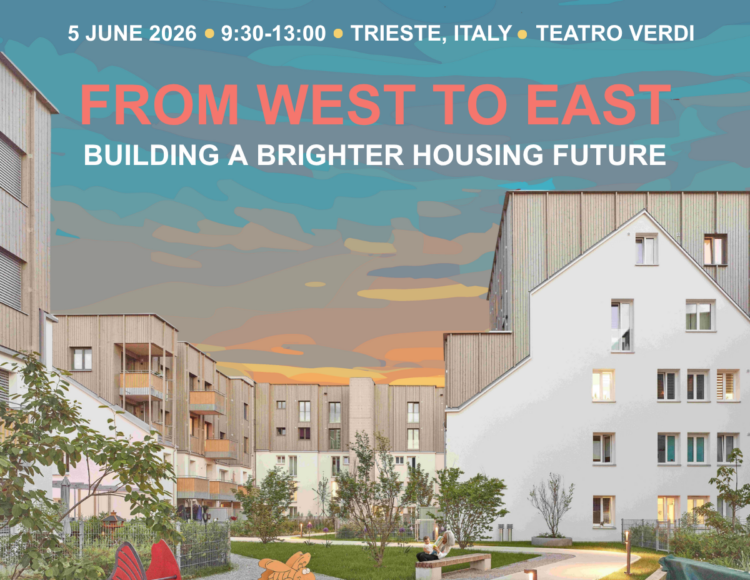
It is against this backdrop that Housing Europe’s Annual Conference will gather housing leaders, policymakers and practitioners on 5 June (9:30–13:30) in Trieste, Italy to explore how Europe can build better housing systems by learning from one another.
Organised by the voice of public, cooperative, and social housing providers, Housing Europe in close collaboration with the Italian public housing federation, Federcasa, and the country’s oldest public housing authority, ATER Trieste, the event will focus on practical solutions that can travel across borders, from West to East and back again, while addressing the structural imbalances that continue to shape housing systems across Europe.
Public, cooperative, and social housing leaders are already working together on how to rebuild housing in Ukraine, exploring ways to establish revolving funds for sustainable investment, and sharing strategies to bring vacant homes back into use and to boost inclusion and quality of life in neighbourhoods. These exchanges reveal that Europe’s housing future will increasingly depend on shared knowledge, solidarity and cooperation.
The gathering in Trieste will be a moment to reconnect housing policy with its deeper purpose to empower people, strengthen communities and restore confidence in the future.
If Europe is to respond to the housing crisis, it will need more than plans and programmes, it will require leadership, hope and the determination to do better and faster with a social heart.

5 June 2026 from 9:30 to 13:30 CET in Trieste, Teatro Verdi (Ridotto Room – ENTRANCE Via San Carlo 4)
PROGRAMME
09:00 – 09:30 Coffee & registration
09:30 – 09:35 Welcome to Trieste
Cristina Amirante
Regional Councillor for Infrastructure and the Environment – Autonomous Region of Friuli Venezia Giulia
09:35 – 10:00 The ingredients of a brighter housing future
Moderated by Sorcha Edwards
Europe’s public, cooperative and social housing secor is being asked to do more with less while responding to rising construction costs, growing waiting lists and increasing pressure on urban and rural communities alike. This opening session will explore how public, cooperative and social housing can remain a driver of stability and optimism despite economic uncertainty and political fragmentation. Speakers from Housing Europe, FEDERCASA and the city of Trieste will discuss why long-term investment, stronger public leadership and trusted local institutions are essential ingredients for a fairer housing future. The conversation will also highlight the importance of protecting housing from short-term thinking and recognising it as critical infrastructure for Europe’s social resilience from West to East.
Marco Corradi
President of Housing Europe
Marco Buttieri
President of FEDERCASA, Italy
Rossana Zaccaria
President of Legacoop Abitanti, Italy
Daniele Mosetti
President of ATER Trieste
10:00 – 10:25 Keynote address (online conversation)
Moderated by Sorcha Edwards
Housing has moved from being treated as a national social issue to becoming a strategic European concern linked to competitiveness, inequality and democratic trust. As Chair of the European Parliament’s HOUS Committee, Irene Tinagli will reflect on the first year and a half of the committee dedicated to improving the housing situiation, the role the next seven-year EU budget can play in delivering affordable homes, and how to maintain political momentum around the issue. The conversation will explore how European institutions can move from recognition to concrete support for public, cooperative and social housing providers and how housing can remain firmly anchored in the EU political agenda.
Dan Jørgensen
European Commissioner for Energy and Housing (video message)
Irene Tinagli
MEP S&D, Chair of the HOUS Committee (online conversation)
Enrico Letta
President of the Jacques Delors Institute (video message)
10:25 – 10:50 Accelerating housing delivery and recovering empty homes with the community in mind
Moderated by Alice Pittini
In the Netherlands, social housing associations already provide nearly 30% of all primary dwellings and are expected to build more than 270,000 additional social homes by 2034 despite mounting political and financial uncertainty. Slovenia is scaling up its ambitions through a new legislative housing package backed by €100 million annually to support the construction of 20,000 public rental homes by 2035. Meanwhile, Italy’s Emilia-Romagna Region is investing €300 million to rehabilitate vacant public housing and expand social housing supply. This session will explore how stronger public investment, stable policy frameworks and the recovery of empty homes can help accelerate housing delivery without losing sight of affordability and community needs. We will also bring in experiences from Flanders, where social housing providers are increasingly exploring the redevelopment of existing buildings and urging municipalities to prioritise vacant public real estate for social housing rather than selling it onto the private market.
Liesbeth Spies
President of the Dutch Association of Housing Corporations (Aedes)
Črtomir Remec
Director at Housing Fund of the Republic of Slovenia
Björn Mallants
General Manager of social housing company Woontrots in Flanders Belgium
Giovanni Paglia
Regional Councillor for Housing Policies, Emilia-Romagna Region, Italy
10:50 – 11:15 Shielding tenants from the energy crisis and reducing CO2 through renovation and local energy production
Moderated by Dara Turbnull
Europe’s mission-led housing providers are once again confronting an uncomfortable reality, a mix energy insecurity, rising living costs and climate pressures. They are responding through large-scale renovation, local energy production and industrialised construction methods designed to lower bills while accelerating decarbonisation. Hamburg’s long-running Alliance for Housing has shown how cooperation between the city, housing companies and developers can sustain high levels of affordable and energy-efficient construction, while balancing climate targets with rent affordability and support for cooperative, community-led projects. The discussion will also spotlight initiatives such as France’s Alliance of Social Housing Providers for Renewable Energy, launched by USH in late 2025, and the growing role of social housing providers as testing grounds for renovation toolkits and offsite retrofit factories.
The debate follows the joint declaration presented by Housing Europe, Energy Cities and the European Builders Confederation in Guimarães in April, calling for cleaner and more decentralised energy systems capable of strengthening both Europe’s resilience and household energy independence.
Özgür Öner
Director of the EU representation of the German Federation of Real Estate and Housing Associations (GdW)
Remy Vasseur
Engineer in Environment and Energy at the French Union of Social Housing (USH)
Claudio Del Pero
Associate Professor at Politecnico di Milano
Julien Dijol
Policy Director at Housing Europe
11:15 – 11:40 The investments that lock in affordability for decades
Moderated by Alice Pittini
One of the central questions facing Europe is how to finance housing that remains genuinely affordable not just today, but for future generations. This session will bring together financial institutions and housing leaders to discuss investment models that prioritise permanence, stability and social return over speculative gains. Speakers from the EIB, CEB and Denmark’s non-profit housing sector will explore tools such as revolving funds, low-interest loans and public guarantees that can sustain affordability over decades. The discussion reflects growing calls from Housing Europe for EU financial frameworks that recognise social housing as essential infrastructure deserving long-term support.
Tanguy Desrousseaux
Director of the Housing, Cities & Regions Department, European Investment Bank (EIB)
Johannes Böhmer
Vice-Governor for Social Development Strategy of the Council of Europe Development Bank (CEB) (online)
Bent Madsen
CEO of B.L., the Danish Federation of Non-profit Housing Providers
11:40 – 12:00 ☕ Coffee break
12:00 – 12:25 Rebuilding a country and a housing system
Moderated by Diana Yordanova
Ukraine’s reconstruction challenge goes far beyond replacing destroyed buildings. If done right, it should be about rebuilding communities, public trust and housing systems that can withstand future crises. Drawing on experiences from Poland, Croatia and Spain, speakers will reflect on how public, cooperative and social housing approaches can help create resilient, inclusive neighbourhoods while avoiding the risks of speculation and short-term thinking.
The conversation will explore lessons from post-war recovery, housing system reform and the development of affordable housing policies, while raising broader questions about how Europe can support housing systems that remain resilient in the face of war, climate shocks, demographic change and economic instability.
Alongside discussions on financing, governance and long-term resilience, the exchange will also examine how new housing systems and institutions can emerge and grow. Experiences from Spain, where organisations such as Provivienda are helping shape a regulatory framework for social housing providers in a system that has historically lacked formal recognition for the sector, will offer insights into the role of policy innovation, institutional development and mission-led housing providers in creating lasting housing solutions.
Adam Czerniak
Deputy President of the Polish National Real Estate Resource
Sanja Jerković
Sanja Jerković
Head of Housing Quality, Property Valuation & Public Utilities
Ministry of Physical Planning, Construction and State Assets
Dámaris Barajas Sanz
Director Strategic Planification, Provivienda, Spain
12:25 – 12:50 Social housing and cooperative models crossing borders
Moderated by Dara Turbnull
Growing attention is turning to cost-rental housing models that set rents according to the actual cost of delivering, managing and maintaining homes over the long term. This panel will look at how countries such as Austria, Denmark and Finland have built large-scale cost-based systems that allow housing providers to reinvest operating surpluses into new construction, renovation and energy transition measures while keeping rents stable and below market levels. These models are increasingly travelling across borders. Ireland has drawn important lessons from Austria’s “closed-loop” housing system in shaping its own cost-rental approach, while Austrian housing experts have recently worked with partners in Spain to examine how elements of the model could be adapted locally.
Sostre Cívic will share its own of building cooperative housing in Spain based on a collective ownership model, where residents manage homes through non-profit cooperatives that remove housing from speculative market dynamics and preserve affordability, community participation and long-term housing security across generations.
Bernd Riessland
Scientific advisor for the Austrian Federation of Limited-Profit Housing Associations (GBV)
Donal Mc Manus
CEO of the Irish Council for Social Housing (ICSH)
José Téllez
Communications Director at Sostre Civic, Spain
Ana Isabel Silvestre Navarro
Legal Officer at the Spanish Association of Public Housing and Land Managers (AVS)
12:50 – 13:15 The politics of housing attention and how a European Affordable Housing Plan can sustain focus
Moderated by Diana Yordanova
Housing is finally receiving unprecedented political attention in Brussels, but many in the sector fear that momentum could fade without structural action and sustained investment. This session will debate how the future European Affordable Housing Plan could help keep housing high on the political agenda while supporting local and national housing providers facing mounting pressures. Speakers will reflect on how political change can both accelerate but also delay housing affordability ambitions, and what mechanisms are needed to preserve long-term commitment beyond electoral timelines.
Jouni Parkkonen
CEO of the Association for the Promotion of Affordable Rental Housing (KOVA)
Daniel Ryšávka
Director of the State Investment Promotion Fund (SFPI) in the Czech Republic
Matthew Baldwin
Head of Housing Task Force (online)
13:15 – 13:30 Closing reflections from West to East
Sorcha Edwards
Secretary General of Housing Europe
▶︎ •၊၊||၊|။|||| | FOLLOW THE EVENT ONLINE VIA THIS LINK.