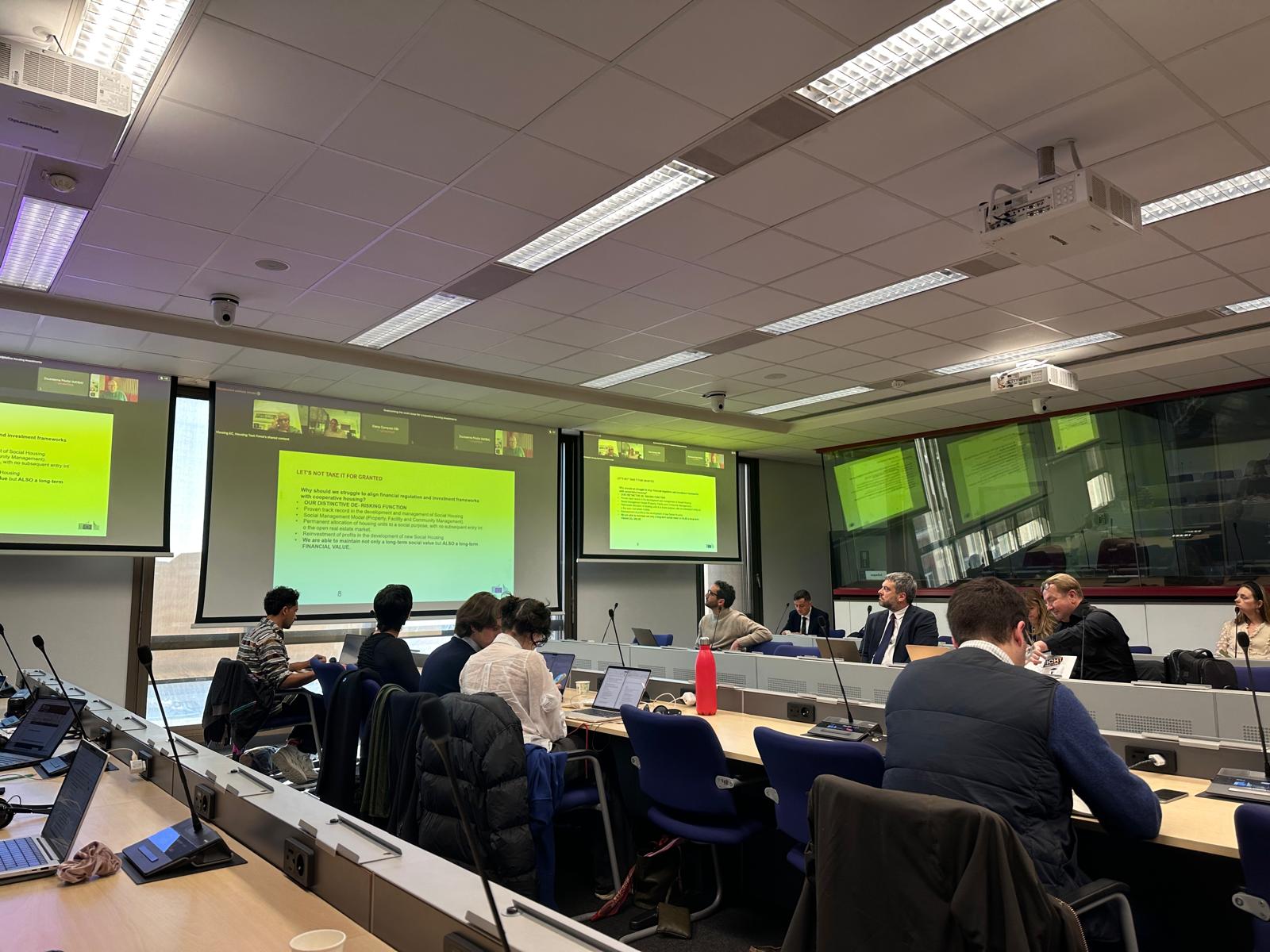
Cooperative housing providers have projects ready to develop, and European lenders are expanding their housing finance. So why is it still so hard to connect the two? At a workshop in Brussels on 5 November, the European Commission’s Housing Task Force, together with its Directorate-General for Economic and Financial Affairs, the European Investment Bank (EIB) and the Council of Europe Development Bank (CEB), brought housing providers and lenders together to look at what’s missing.
Stefan Moser of the Housing Task Force argued that exclusion from long-term capital is a structural problem that needs to change. Direct EIB loans typically start at €25 million, putting them beyond the reach of many individual projects. As the EIB works to increase its annual housing lending from around €3 billion to €6 billion, the question is how to bring projects together for financing without asking providers to build bigger developments than their communities need.
What cooperative housing brings
Rossana Zaccaria of Legacoop Abitanti made the case for recognising cooperatives in the European Affordable Housing Plan. She pointed to an Italian sector with more than 400 cooperatives, around 2 million members and 45,000 homes, with occupancy close to 100% and rent arrears of 2–3%. Cooperatives combine property and community management, keep homes in social use and reinvest surpluses in new housing. A pipeline of around €100 million was identified at an EIB workshop in September, and a regional guarantee is being tested in Lombardy with Fondazione Cariplo and local cooperatives.
How European finance can reach local projects
Bent Madsen described how Denmark’s National Building Fund already pools resources across the sector. Financed through tenants’ rents, the revolving fund supports major renovations and neighbourhood social programmes. He said it could also deploy financing from European public banks alongside its own resources, adding to what the sector can invest rather than replacing it.
Bernd Riessland explained how Austrian banks have channelled EIB finance to housing providers for decades. But holding long-term loans on bank balance sheets has limits, and individual bond issues can struggle to attract investors. He proposed pooling loans in dedicated funds with liquidity buffers and standard refinancing agreements. Local partners would still assess and finance individual developments. As he put it, the answer is not to make the projects bigger.
Sorcha Edwards of Housing Europe pointed to the value of European lenders strengthening intermediaries rather than assessing developments one by one. She cited the French example, involving the EIB, the CEB, L’Union sociale pour l’habitat and Groupe Caisse des Dépôts, as a way to reach projects of different types and sizes. Direct lending can also work where the scale fits: in Catalonia, Sostre Cívic presented its plans at a pitching session organised by Housing Europe’s European Responsible Housing Finance Working Group and subsequently secured a €31 million CEB loan backed by InvestEU to support more than 350 affordable cooperative homes.
Where the gaps remain
eert de Pauw of Community Land Trust Brussels brought a concrete proposal to the discussion. With €24 million already secured and a further €12.5 million needed, the organisation is seeking a 50-year loan at 2%. Could financing on those terms help keep homes affordable over the long run? If so, what mix of long-term lending, public guarantees and grant support could make it possible? The case also illustrates why grants remain important: even low-cost loans have to be repaid, and in some projects debt alone cannot deliver the affordability households need.
Risk assessment also remains open. The European Banking Authority pointed to what the current rules already allow, while Riessland described an Austrian supervisor-approved approach that can bring risk weights down to 50% where providers meet certain equity conditions. The workshop identified scope to explore whether that approach could work elsewhere and to test new ways of pooling projects.
The aim is to scale the financing, not the developments. Guarantees, well-resourced intermediaries and risk assessments that reflect how cooperatives operate could help more providers access long-term finance while keeping decisions about what to build rooted locally.
Housing Europe thanks the Commission’s Housing Task Force, particularly Stefan Moser, Edit Lakatos and Charlie Watson, for facilitating the exchange.