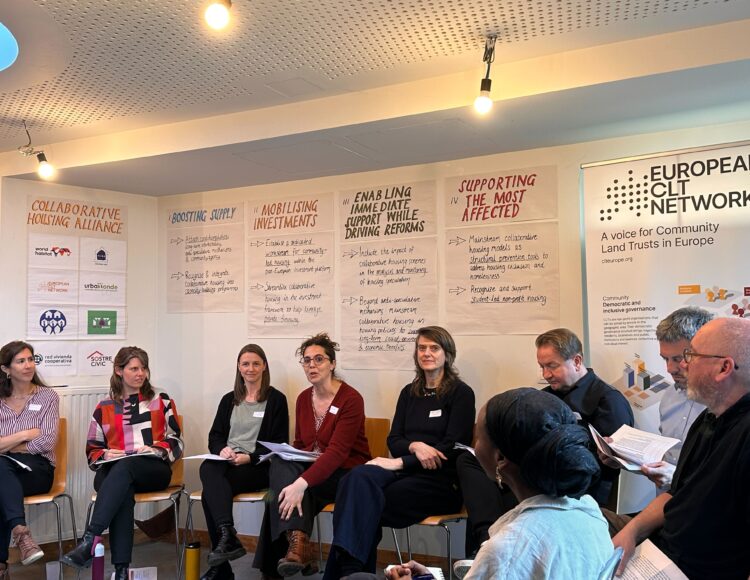
As the European Union moves into the implementation phase of its European Affordable Housing Plan, including work on the Affordable Housing Act, the housing simplification package, the upcoming pan-European Investment Platform and negotiations on the next Multiannual Financial Framework (MFF), housing actors across Europe are stepping up engagement to ensure that long-term affordability remains at the centre of delivery.
Housing Europe members participated in a meeting of the Collaborative Housing Alliance hosted at Arc-en-Ciel, a development of Community Land Trust Brussels in Molenbeek, Brussels. The Alliance brings together organisations including World Habitat, MOBA Housing, the European CLT Network, urbaMonde, the European Student Cooperative Housing Alliance, the NETCO project, Red Vivienda Cooperativa and Sostre Cívic.
Arc-en-Ciel: a CLT in Molenbeek, Brussels
The meeting took place at Arc-en-Ciel, a development comprising 32 homes, a collective garden and community space in Molenbeek. Families were involved over several years in architectural choices, governance preparation and defining shared values. Since moving in, residents have continued to organise neighbourhood initiatives that strengthen social cohesion.
The Community Land Trust model separates ownership of land and buildings, removing land from the speculative market and applying resale formulas to maintain affordability over time. As discussed during the meeting, this is one possible approach to safeguarding public investment for future generations. Cooperative housing, limited-profit housing companies and other non-profit models pursue similar long-term objectives through different legal and financial structures.
The exchange followed four pillars drawn from the European Affordable Housing Plan — boosting supply, mobilising investment, enabling reforms, and supporting the most affected — linking local practice directly to EU implementation priorities.
Boosting Supply: Permanent affordability and safeguards
A central message of the meeting was the need to move beyond isolated pilot projects. Public support should generate permanent affordability rather than temporary subsidy. Participants emphasised:
- Safeguards against speculation
- Clear conditionality in public funding
- Legal recognition enabling non-profit housing providers to access land and finance, including within the Services of General Economic Interest framework
The scale of development illustrates that these models are no longer marginal. In just over a decade, Community Land Trusts in Europe have grown to more than 350 initiatives, delivering around 7,000 homes, with approximately 25,000 additional homes in the pipeline. In Berlin, housing cooperatives account for around 10% of the housing stock and maintain some of the lowest average rents in the city. Across Europe, limited-profit and cooperative providers demonstrate that alternative ownership and governance models can deliver stable affordability at scale.
Mobilising investment: Building a non-profit finance ecosystem
Financing was a key focus of the discussion, particularly in light of upcoming EU investment initiatives and the next MFF. Participants underlined the importance of strengthening an ecosystem of public, cooperative and ethical finance capable of supporting non-profit housing without extracting excessive returns.
In Catalonia, Sostre Cívic secured a €31 million loan from the Council of Europe Development Bank, illustrating growing institutional recognition of cooperative housing as a reliable non-profit provider. Across Central and Southeast Europe, MOBA Housing has developed an accelerator mechanism providing early-stage finance to emerging cooperative housing projects. The model recycles repayments into new developments, helping to build intermediary capacity in regions where public or cooperative housing sectors remain limited. Its first €100,000 loan supported a student housing cooperative in Budapest.
Ethical banking partnerships were also highlighted, including examples such as GLS Bank in Germany, Coop57 in Catalonia or Rabobank in the Netherlands, together with other mission-driven finance institutions supporting non-profit housing initiatives.
As the EU develops its Investment Platform and defines housing-related investment criteria under the MFF, ensuring that finance delivers long-term social value — rather than short-term returns — will be decisive.
Enabling Immediate Support While Driving Structural Reform
Collaborative housing projects are active in renovation, climate resilience and social inclusion. Initiatives such as the Interreg “Upcycling Trust” show how upgrading homes to high energy standards can be combined with protections against displacement and speculation, ensuring that renovation benefits are not lost through rising land values.
Participants also underlined the role of collaborative housing in student accommodation, homelessness prevention and socially mixed neighbourhoods. While tailored responses are needed for specific groups, expanding non-profit housing remains a structural response to financialised housing markets.
Supporting the Most Affected: Inclusion and Prevention
Discussions addressed how collaborative housing can contribute to supporting vulnerable groups, including students and households at risk of homelessness.
Student housing cooperatives provide affordable accommodation combined with democratic governance and shared responsibility. Community-led models can also contribute to long-term stability for households exiting precarious housing situations, combining prevention with permanence.
Structural Reform and Critical Mass
Housing Europe Secretary General Sorcha Edwards stressed that Europe needs a critical mass of genuinely affordable housing to counter financialisation. While specialised solutions remain important, long-term affordability depends on scaling non-profit provision and advancing structural reform of housing finance and land systems.
Matthew Baldwin, Chief of the European Commission’s Housing Task Force, welcomed the dialogue, underlining the importance of practical experience from the ground as implementation advances.
As Geert De Pauw of Community Land Trust Brussels put it during the discussion, collaborative housing actors are not asking for “a bigger slice of the cake,” but demonstrating that they are already “baking it together” in neighbourhoods across Europe. The exchange at Arc-en-Ciel reflected a growing convergence across housing actors: Europe’s affordability challenge cannot be addressed through short-term measures alone. As the EU implements its housing agenda, ensuring that public, cooperative and community-led housing providers are recognised as structural partners will be central to delivering lasting social value.