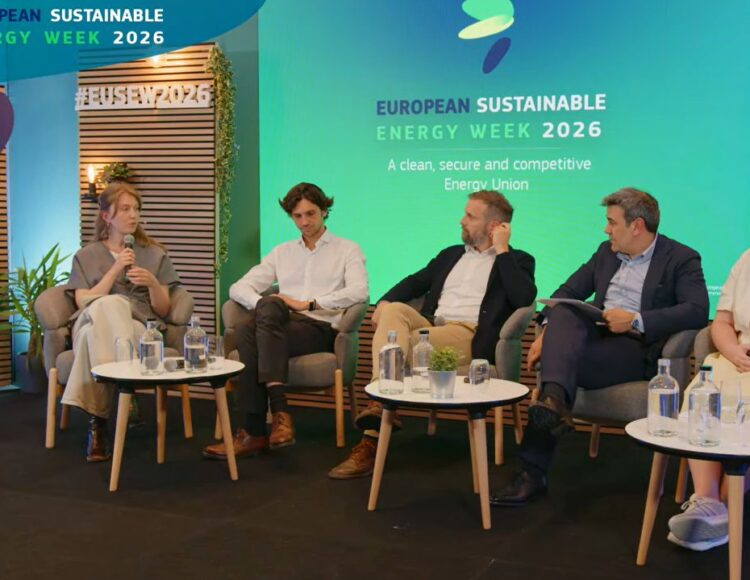
What happens when affordable housing providers become active players in Europe’s energy transition? At EUSEW 2026, Housing Europe member Public Housing Sweden clearly said that the technology to deliver cheaper, locally produced renewable energy to tenants already exists. Now Europe needs to remove the barriers preventing it from being deployed at scale.
Energy communities, affordable housing and Europe’s ambition for a fairer Energy Union came together during the EU Sustainable Energy Week session “Europe’s powerhouse: energy communities and affordable housing for a just Energy Union”, held on 10 June in Brussels.
Representing the affordable housing sector on the panel was Björn Berggren, Energy Expert at Public Housing Sweden, a Housing Europe member representing municipal housing companies that together account for almost 20% of Sweden’s housing stock and around half of the country’s rental sector. His work focuses on energy efficiency, climate transition and sustainable housing while safeguarding affordability and long-term resilience.
His intervention offered a particularly concrete perspective on what energy communities can look like when the housing provider itself takes an active role. In the Swedish public housing context, Berggren explained, municipal housing companies can effectively take charge of developing the energy community. Their long-term ownership model changes the economics of investment: these organisations are not investing in buildings for a quick return or preparing to sell them, but managing homes over decades.
That makes investments such as rooftop photovoltaics particularly interesting. As Berggren put it, renewable energy produced through these long-term investments can ultimately be supplied to tenants at a lower cost than alternative energy sources. In other words, the rooftop of an affordable housing building is not simply an asset for decarbonisation. It can become part of the infrastructure for keeping residents’ energy costs down.
Public Housing Sweden also highlighted the gap between what is technically possible and what Europe’s energy system currently enables. Asked about the biggest obstacles to bringing energy communities into social housing, his answer was remarkably straightforward: time and the grid. Public housing companies may be ready to install significant amounts of solar PV, but grid constraints can mean projects are told that additional production cannot be accommodated, potentially resulting in years of waiting.
The response emerging in Sweden is what Berggren described as a “smart energy community”: combining solar PV with battery storage so locally generated electricity can benefit tenants while simultaneously reducing pressure on the electricity grid. This creates the kind of multiple benefit Europe increasingly needs. Affordable housing providers can produce renewable electricity, tenants can benefit from lower energy bills, and energy communities can help provide greater flexibility to the wider electricity system.
“The technology is there,” Bjorn Berggren stressed. The challenge is speeding up the processes that allow it to be used.
That distinction matters and Europe does not necessarily need to wait for a new technological breakthrough before energy communities can deliver for affordable housing residents. In many cases, the solutions already exist – grid access, permitting, regulation, financing and organisational capacity will determine how quickly they reach households.
Moderated by Heleen Schockaert, Senior Expert on Energy Poverty at REScoop.eu and partner in the SOCIALNRG project, she underlined that affordable housing, citizen energy and building renovation are increasingly converging on the European agenda. The challenge is therefore not simply to produce more renewable energy, but to make sure households, including those most exposed to energy and housing costs, can participate in and benefit from the transition.
For Housing Europe, this question is also at the core of SOCIALNRG, the European project coordinated by Housing Europe which is working to strengthen the connection between social housing providers and energy communities.
Energy communities cannot depend on residents navigating complexity alone was also one of the strongest threads running through the discussion moderated by Heleen Schockaert.
Energy communities are often presented as instruments of citizen empowerment, but participation cannot be considered inclusive simply because everyone formally has the right to join. People facing high energy costs or other forms of vulnerability are often being asked to navigate increasingly complex systems: renovation programmes, subsidies, smart technologies, dynamic tariffs and administrative procedures. Several interventions during the session pointed to the need for trusted intermediaries that can carry part of this complexity instead of placing it entirely on individual households.
For affordable housing, that creates an important opportunity. Housing providers already have a long-term relationship with buildings and residents. Energy communities bring collective ownership, local participation and renewable energy expertise. Connecting the two can create structures in which residents benefit from the energy transition without first having to become energy-market experts themselves.
That is precisely where cooperation between the social housing and community energy movements becomes particularly powerful.
SOCIALNRG: building the bridge between two movements
This connection is at the heart of SOCIALNRG, coordinated by Housing Europe with REScoop.eu among its partners. The project starts from the idea that social housing providers and energy communities have complementary strengths.
Housing providers bring buildings, long-term investment horizons, professional asset management and trusted relationships with residents. Energy communities bring experience with collective renewable generation, citizen participation and democratic approaches to energy. Bringing these ecosystems together can help make community energy accessible to households that have too often been left outside citizen-led energy initiatives.
The EUSEW discussion showed why this bridge matters in practice. Bjorn Berggren’s Swedish experience demonstrates what becomes possible when a public housing provider can take responsibility for developing renewable energy infrastructure on behalf of and for the benefit of its tenants. At the same time, Schockaert’s moderation kept the discussion focused on the central social question: who is actually able to participate in Europe’s energy transition, and who carries the complexity required to do so?
These are exactly the questions that need to be answered if energy communities are to move from promising local initiatives towards a model capable of reaching affordable housing residents across Europe.
We see signs that there is a growing place for affordable housing in EU energy policy. European Commission representative Achille Hannoset pointed to the growing recognition of energy communities within EU affordable housing and energy policy. He highlighted their potential role as trusted intermediaries, including in building renovation and solar deployment, as well as the Commission’s work to support financing, awareness and capacity building for energy communities.
He also stressed the role of “enablers” – organisations capable of connecting households with knowledge, services and support – and confirmed the place of energy communities within the EU’s approach to tackling the affordable housing challenge.
For the affordable housing sector, this opens an important window. The discussion in Brussels ultimately pointed towards a broader transformation in how Europe thinks about housing and energy.
Affordable housing buildings should not be seen only as places where energy is consumed or where renovation targets must be met. Their rooftops, shared infrastructure, neighbourhood scale and long-term management structures make them potential building blocks of a more decentralised energy system. Their residents should not be treated merely as consumers receiving the consequences of Europe’s energy transition.
With the right models, they can share in its benefits. The experience presented by Public Housing Sweden offers a glimpse of what that can mean: locally produced renewable electricity, lower bills for tenants, storage that helps relieve pressure on the grid, and housing organisations investing with a time horizon measured in decades rather than years.
For Housing Europe and the SOCIALNRG partnership, the next step is turning examples such as these into approaches that can travel across borders and different housing systems.