This project was a finalist in the European Responsible Housing Awards 2022 under the ‘Leaders of Innovation, agents of fair energy transition’, organised by Housing Europe, the International Union of Tenants and DELPHIS.
Organisation: Woonpunt Zennevallei
Goals
- Deep energy retrofit of 184 units of the Vogelweelde neighbourhood in Halle, Flanders to tackle energy poverty and achieve regulatory compliance in the most cost-effective way possible
- To find a solution that brings together, design, works, quality control, and verification of the energy performance and energy savings really delivered with new emerging energy performance monitoring technology
- To come up with solution that really involved the residents from the outset via engagement meetings, one on one contacts and follow-ups, and availability of a contact point at all times from start to finish of the works
Context
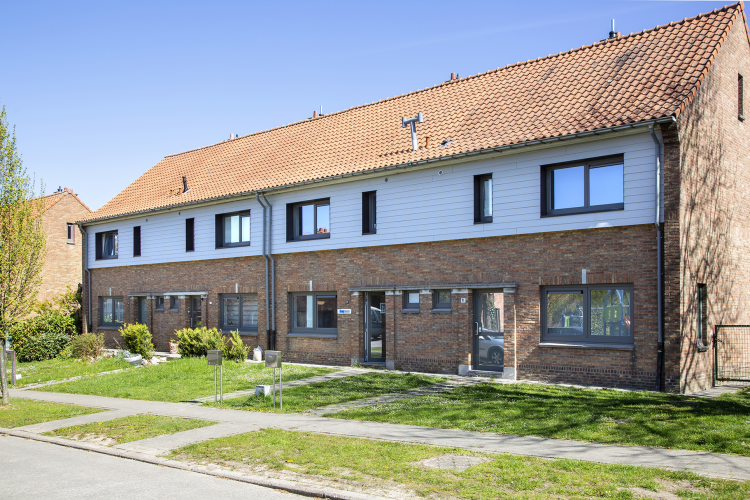
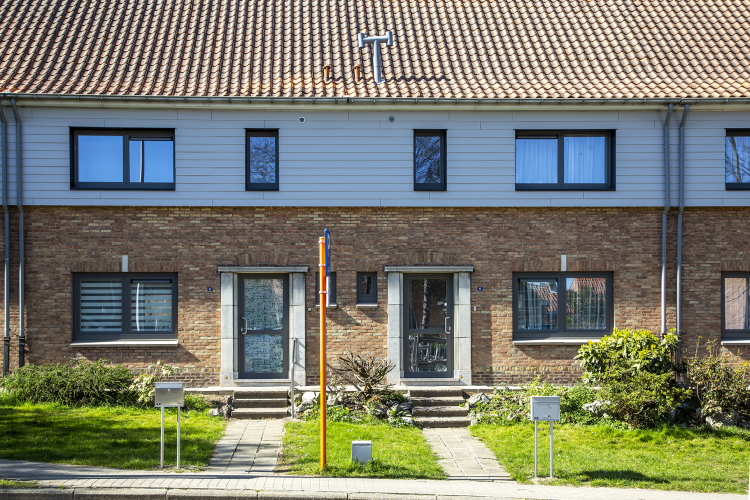
The neighbourhood is characterised by open spaces and yards, as well as green areas with trees and pedestrian zones. The outside areas that are closed for tenants inLeeuwerikenlaan and Merellaan have been deisgned with shared spaces, including a playground. The district has been built in two phases – one witt almost a hundred homes in 1955 and another 100 four years later, in 1959.
Before the renovation
After multiple smaller renovation projects focusing on individual parts of the envelope such as windows and doors or roofs as instructed by the Flemish Society for Social Housing (VMSW), WPZ decided to focus on a full energetic renovation that would first be trialed on an estate close to their headquarter (the Vogelweelde).
Woonpunt Zennevallei chose a provider that could carry out the large-scale renovation because it wanted a solution that was able to show the real energy savings achieved by the renovation and then deliver those savings backed up by a warranty.
Before monitoring equipment was installed and works began, the service provider organised a number of events at the local community centre, to engage the citizens and ensure they are heard. A contact person was available on site and by telephone throughout the whole process.
Prior to the renovation, the company monitored a range of buildings for three months to assess the baseline energy performance of each home type with state-of-the-art technology and cloud data algorithms. Using this data, the company was able to demonstrate a range of achievable energy savings based on four potential renovation scenarios.
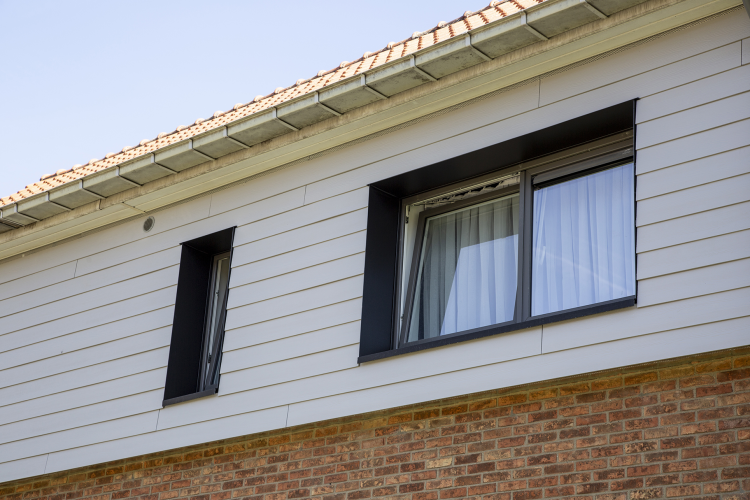
The renovation included ventilation and heating upgrades alongside the installation of high-quality insulation systems with membranes, tape, cavity wall insulation and external wall systems to improve the thermal performance of solid upper walls.
Besides the challenges of the pandemic, which resulted in periods of on-and-off work, it was essential that the residents remained in their homes while the renovation was carried out to avoid putting pressure on other areas of the housing stock. This meant that the health, safety, and well-being of residents were paramount during the renovation and strict standards of conduct were applied to everyone on-site supported by outstanding resident liaisons at every stage.
What is innovative about this project?
The project benefitted from two types of innovation:
1) Implementation of the project according to a one-stop-shop approach
The project was the first of its kind in Belgium for residential housing owned by the social housing companies, where the resident engagement, design, works, and quality control were brought together by a single contractor. This was made possible by a special tendering approach developed by Woonpunt Zennevallei.)
2) Measurement of real energy performance, before and after works had been completed
This was the first large-scale renovation project to use a special negaWatt hour technology. This means that for the first time a social housing company can really know the real energy performance delivered by the renovation rather than relying on the EPC calculation.
3) Energy performance backed up by a contractual warranty
While common in other sectors, this is the first time any project we are aware of in the social housing sector has been backed up by a contractual warranty, meaning that if the promised performance is not delivered in practice, then the service provider has to investigate and solve the problem.
Interventions
Woonpunt Zennevallei developed a new type of tendering to procure the deep energy retrofit of the Vogelweelde neighbourhood. Until recently social housing companies tendered for energy renovations according to a –design-bid-build approach. This would entail one tender for works and another for design, leading to a huge amount of time and administrative burden in preparing these projects. With this new, ‘design and build’ type tender, it means that we can procure energy renovations in a much more time-efficient way.
Impact
The energy-saving results will be announced in early 2022, but already improvements of 26% have been recorded a negaWatt(1) hour technology following the installation of the loft installation system.
A key benefit is the savings for tenants on their energy bill, with an estimated average annual saving of almost 800 euros. Given the evolution of gas prices, we would expect the savings to be even higher with this project.
Measurement of energy performance before and after the project to verify if the promised energy performance had been delivered in practice. A key benefit is that it ensures that the contractor has achieved what they promised and can be held to this promise in a contractual warranty.
This insight into how the investment really performs also enables Woonpunt to know what the real return on investment is for deep energy retrofit projects and helps inform future decisions regarding improving the energy performance of the housing stock and decarbonisation of the heating supply.
Real performance monitoring also offers key insights at the pre-monitoring phase, to show how disadvantages of poor thermal performance are unevenly distributed i.e. residents in homes with different orientations and types may find it more difficult to heat their homes, pay more for their heating bills, than other residents even though their houses are notionally the same standard in EPB calculations.
[1] A negaWatt is a watt of energy that has not been used through energy conservation or the use of energy-efficient products. Source: https://www.renewableenergyworld.com/energy-efficiency/whats-a-negawatt/#gref
Lessons learned
- One-stop-shop approach bringing together a housing association, residents, designers, works, and quality control by a single contractor. An innovative tendering approach that makes the process faster and less bureaucratic.
- Measurement of real energy performance, before and after works had been completed and reported.
- Focus not only on energy efficiency but also to reduce energy poverty, with 800 euros yearly energy savings for a tenant.
- Transparency for the social housing company on energy performance.