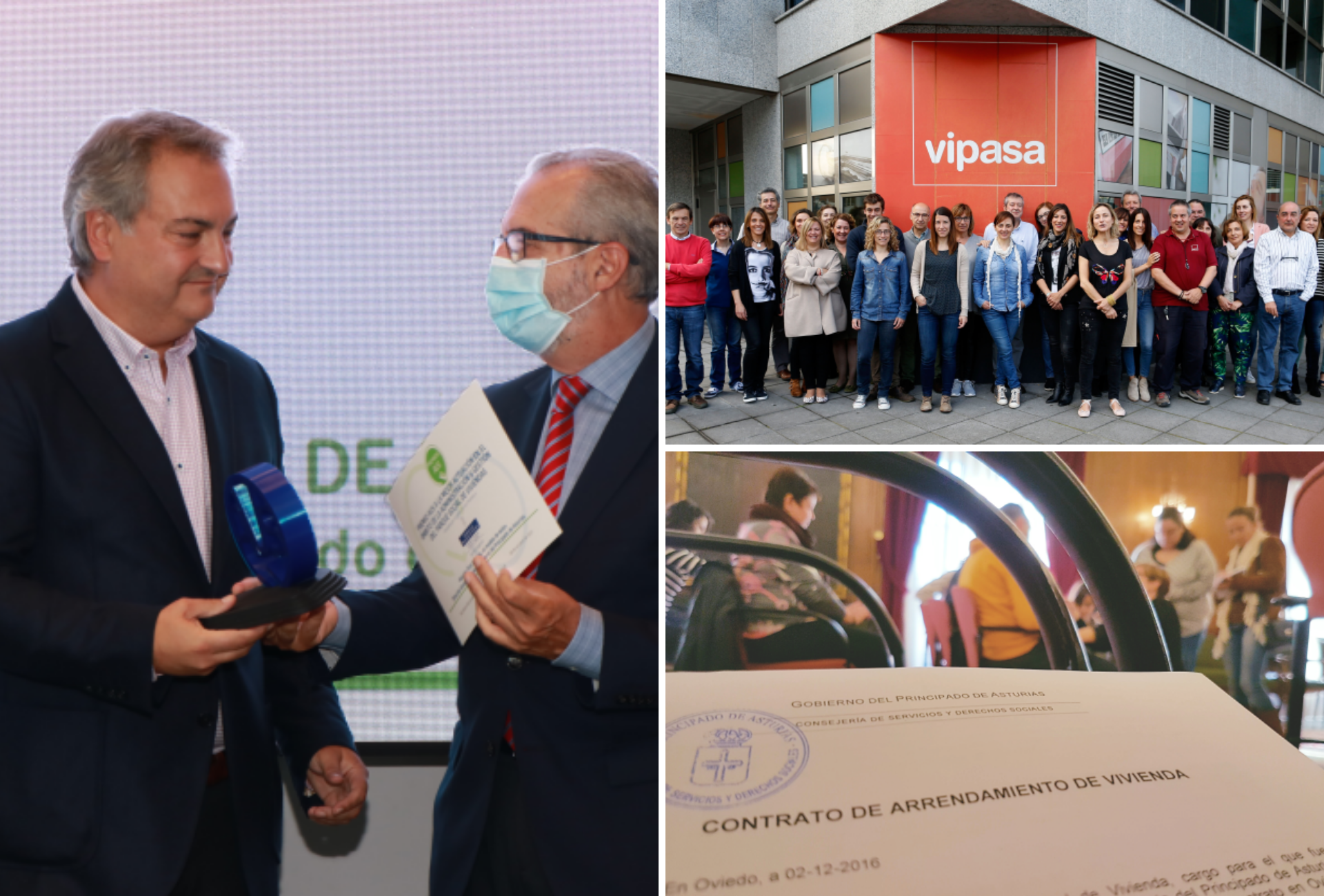
This project was a finalist in the European Responsible Housing Awards 2022 under the ‘More than a roof – supporting communities of equal opportunities’, organised by Housing Europe, the International Union of Tenants and DELPHIS.
Organisation: Visapa and Directorate General for Housing in Asturias
Goals
The main objective of the project is to eradicate homelessness in the Asturias region, ensuring public dwellings for homeless people, and guaranteeing their right to housing, by signing the rental contract and becoming a real TENANT, as a subject of rights and duties in the framework of the Spanish Rental Housing Law.
Other objectives of the project were:
- To increase the commitment and participation of Housing public administration (at a regional and local level) in the Housing First programmes.
- To improve the coordination between different levels of administration in housing policy, with special attention to the development of Housing First projects.
- To guarantee an appropriate public housing stock for combating homelessness.
Context
The Principality of Asturias is a small region in northwest Spain, with one million inhabitants.
At the end of 2015, the Directorate General for Housing in Asturias created the Permanent Working Group on Public Housing. The group, formed of the 78 Asturian municipalities, jointly with the General Directorate of Housing and VIPASA (the public company that manages the public housing stock in Asturias), meets regularly. An objective of this forum was to tackle homelessness, starting with the municipalities where this problem was most critical: Oviedo, Gijón, and Avilés. Near 80 homeless people were identified at the beginning of 2017. El Franco was included later.
The Housing First programme in Asturias is included in the social housing regional system. The main features are the following:
- The Principality of Asturias is the owner of almost 10.000 dwellings, managed by VIPASA. The average rent was 77€ in 2020. The rent is calculated based on the incomes of the tenants, of which it cannot represent more than 20%.
- Social Services from the municipalities, with the collaboration of specialised NGOs, select the beneficiaries of the Housing First programme. The profile is based on a long tradition of living on the street (minimum of three years), addictions and mental health problems, and accumulation of exclusion factors: unemployment, isolation, and lack of family ties.
- At the same time, Social Services support the procedures for obtaining the social income for the beneficiaries. The social income monthly amount ranges from 450€ up to 1.000€. Social Services also financially supports the purchase of furniture.
- VIPASA is responsible for repairing the dwellings and preparing the documentation.
- The selected beneficiary signs the rent contract with the owner of the dwelling (General Directorate of Housing), under the Spanish law of urban leases. VIPASA gives him/her the keys to the dwelling, and he/she becomes a tenant.
- The specialised NGO, contracted by the participant municipality, starts the support and accompaniment of the beneficiary, to guarantee an effective inclusion in the neighbourhood and facilitate an independent and autonomous life.
A political commitment from the Asturias government is to increase yearly the number of public dwellings for the Housing First programme, until the total eradication of the situation.
The Housing First project in Asturias is a way to tackle four weaknesses in the development of Housing First Programmes:
- Traditionally, homelessness has been approached as an exclusive issue of social services, with solutions being sought through specialized accommodation arrangements (shelters, supervised flats, guesthouses, and hostels). The lack of commitment of public administration with competencies in housing was an important weakness because most of the Housing First programmes in Spain depend on the private housing sector.
- Specialised NGOs, working with homeless people have to look for appropriate dwellings. The different NGOs that are implementing the Housing First model agree that the greatest difficulty they face is managing housing stock. They have to work exhaustively with public administrations, social housing developers, and property owners in order to reach agreements for the transfer of dwellings for this cause. The procedures to access housing are slow, and cumbersome, with a disparity of conditions depending on whether it is a public or private stock, etc.
- Homeless people who access housing have to respect some rules of participation and behaviour established by the NGOs in the Housing First programmes. While they do not have a tenant status and do not need to sign a contract, they are requested to respect the rules as other tenants.
- When the support from the NGO ends (because the beneficiary can live an autonomous life) the beneficiary has to look for another dwelling, which is a very difficult issue in general for citizens, and more difficult for former homeless citizens.
What is innovative about this project?
Although the model is not new and has been developed for years in different Spanish cities, its application in the Principality of Asturias includes innovative features:
- The Housing First programme is managed by the Directorate General for Housing of the Government of the Principality of Asturias, which coordinates its implementation with the municipal social services. The Directorate General of Housing is within the Regional Ministry of Social Rights and Welfare. This in itself is a radical innovation, as the housing available to the programme is guaranteed.
- Housing First Asturias takes place in public, not private, housing stock, and is managed by VIPASA.
- The dwelling is not given to the Social Services or entities that carry out the accompaniment with the beneficiaries (as in the rest of Spain). It is the beneficiary who signs a rental contract. He/she can remain in the dwelling as long as they want.
- Networking is carried out between administration at different levels and third parties.
- The beneficiary is a tenant within the social housing stock, which represents a revolution in Housing First initiative framework.
Interventions
Every year, VIPASA asks every municipality for an annual evaluation. The main aspects of the evaluation are:
- KPI (Key Performance Indicators) such as the evolution of addictions, relationship with family, friends and community, health, diet, maintenance of dwelling, hygiene, self-organisation including domestic economy, participation in employment pathways, and participation in social and leisure activities.
- Monitoring of social accompaniment, through weekly visits and telephone calls.
Impact
47 homeless people accessed a public dwelling.
In qualitative terms and at a general level:
- The almost eradication of homelessness in Asturias in 4 years.
- The provision of an agile procedure of access to housing and accompaniment for homeless people.
At the individual level (of the beneficiaries), there is an improvement in all indicators of autonomous living and social integration:
- hygiene, health, and nutrition
- reduction and overcoming of addictions
- improvement of confidence and self-esteem
- awareness of their rights and duties as citizens and tenants
- participation in activities and workshops of the social centres
- family and social relationships have been restored.
In terms of social awareness, this initiative contributes to the eradication of the stigma of homeless people, by disseminating the successful stories.
The Housing First programme in Asturias has been awarded by the Spanish Social/public housing Association, AVS, with the first prize in the category of ‘Best management of social housing stock’ in 2021.
Lessons learned
- Great example of stakeholder engagement and collaboration through a comprehensive approach.
- The commitment and participation of housing public administration turning in the Housing First programme that involves all the region and local level.
- The coordination between different levels of administration in housing policy; the use of public housing stock for combating homelessness ensuring public dwellings for homeless people, and guaranteeing their right to housing, by signing the rental contract and security of tenure. A clear political commitment that led to the almost eradication of homelessness in the region in 4 years.
- Criteria of selection of the tenants are clearly defined: The profile is based in long tradition of living on the street (minimum three years), addictions and mental health problems, accumulation of exclusion factors: unemployment, isolation, lack of family ties.
- Rent kept under 20% of the tenant’s income.
- Social Services support the procedures for obtaining the social income (a social rent from the national or regional government in Spain) for the beneficiaries.