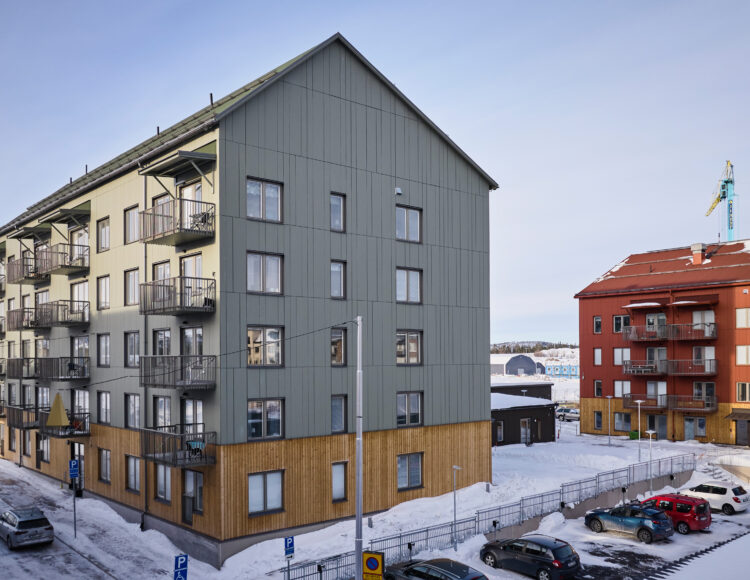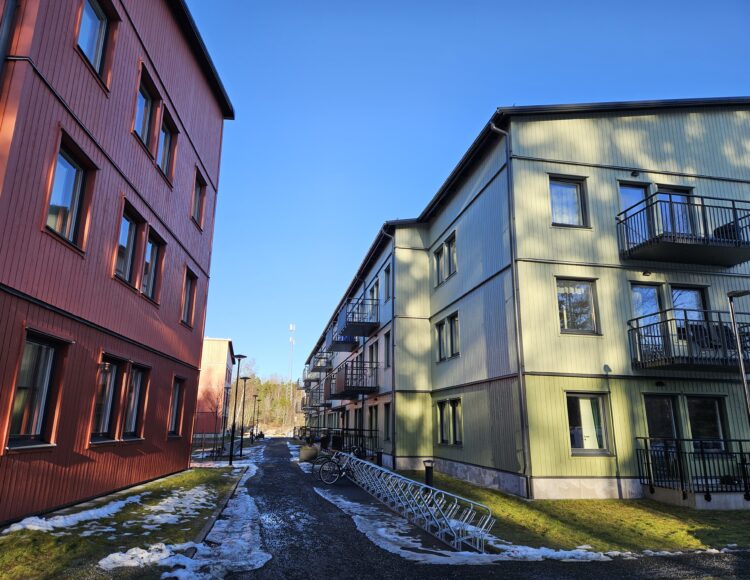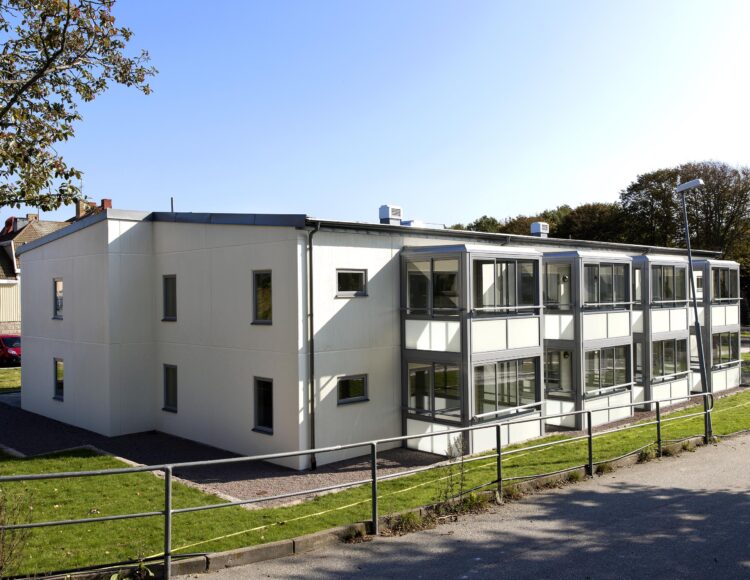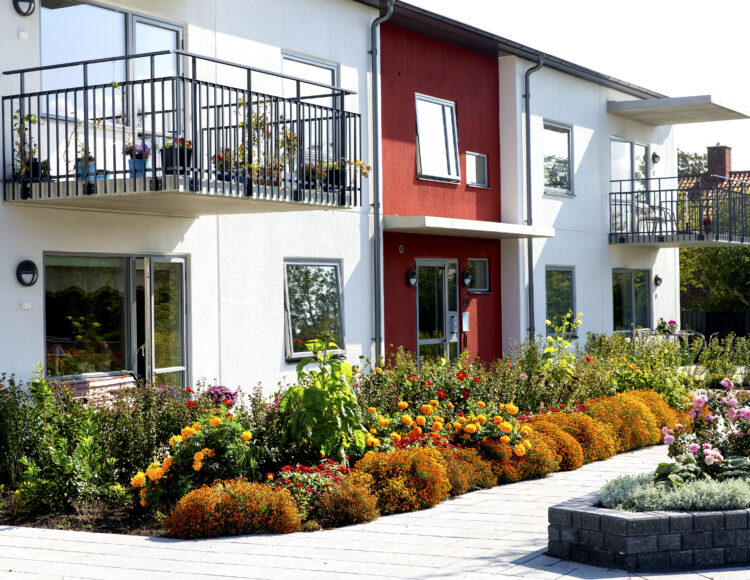
This project was a finalist in the European Responsible Housing Awards 2025 under the ‘Management excellence for housing affordability’, organised by Housing Europe, the International Union of Tenants and DELPHIS.
Organisations: Sveriges Allmännytta – Public Housing Sweden
Goals
The Kombohus initiative, launched by Sveriges Allmännytta (Public Housing Sweden), was developed to address Sweden’s rising construction costs and long-standing housing shortages. Its primary objective is to provide municipal housing companies with access to affordable, high-quality apartment buildings using industrialized construction methods and national framework agreements.
By acting as a central purchasing body for over 300 municipal housing providers, Public Housing Sweden is able to coordinate large-scale procurement and negotiate lower prices. The Kombohus model makes it possible to deliver turnkey multi-storey buildings up to eight floors high, with flexibility in size, shape, and design—tailored to meet local needs and demand across Sweden’s municipalities.
The project particularly supports municipalities that had not built for 15–20 years, helping them re-enter the housing market by providing technical guidance, streamlined processes, and pre-negotiated supply contracts.
Context
Sweden faced a growing housing shortage in the early 2010s, at a time when construction prices were rapidly increasing and many municipal housing companies had limited capacity or recent experience in building. Public housing tenders under the national procurement law (LOU) received few bids, and prices were often significantly higher—on average 10% more than those for private developers.
To change this, Kombohus was launched in 2010 as a standardized, industrial construction concept. It aimed to simplify development and reduce prices through scale, repeatability, and efficiency. Instead of developing one-off housing projects, municipal providers could now order pre-approved building systems under a nationwide framework agreement.
Over 15 years, five such agreements have been signed, enabling construction in 129 municipalities. To date, 11,000 Kombohus apartments have been completed, with around 1,000 more in development. The model covers up to 25,000 homes across current supplier agreements.
What is innovative about this project?
Kombohus breaks with traditional public procurement by focusing on functional requirements rather than detailed technical specifications. This encourages construction companies to innovate in system design, modularity, and energy performance—so long as the buildings meet core criteria on cost, quality, and sustainability.
The model combines industrialized construction techniques with competitive framework contracts, allowing municipalities to order fully designed housing packages that are quick to build and cost-efficient. This not only standardizes quality but also lowers risk and resource burden for smaller or less experienced municipal developers. An additional innovation is the introduction of Byggkalkyl, a web-based planning and cost simulation tool. Housing companies can use it to compare design options, calculate full project costs, and model long-term rental pricing—helping them make informed investment decisions
Interventions
Kombohus relies on a strategic toolkit built around scale, standardization, and shared procurement. Public Housing Sweden coordinates central procurement through national framework agreements involving multiple suppliers. These agreements include standardized modular building designs that can be configured to different sites while maintaining industrial production efficiency.
Procurement is based on performance—particularly energy and architectural quality—rather than prescriptive designs. This creates flexibility for suppliers while maintaining high standards. Manuals and guides support local housing companies through each stage, from planning to delivery.
The digital tool Byggkalkyl is integrated with the framework’s pricing model. It enables companies to simulate various building options and assess financial feasibility early in the project cycle, supporting better planning and rent setting.
Impact
- Construction costs for Kombohus buildings are 20% lower than other public-sector housing, equating to around SEK 6,000 per square metre in savings
- On average, Kombohus developments are completed 5 months faster than comparable public builds and 3 months faster than private-sector equivalents
- In large cities, newly built Kombohus units offer rents 13% lower than private equivalents; in smaller cities, the difference is around 6%
- 11,000 homes completed, with an additional 1,000 in progress across 129 municipalities
- More than 1,200 homes would not have been built without Kombohus; 20% of housing companies involved had not built anything in the previous two decades
- Over one-third of participating housing companies report they would not have been able to build in their chosen locations without the framework
- One in four say Kombohus made it possible to reach specific target groups they otherwise could not have served
Lessons learned
- The project delivers proven affordability: rents 13% below market and significantly reduced construction timelines.
- Public procurement and standardization pressure down construction prices, enabling access in underserved areas.
- Tenants were involved in rent negotiations, supporting the model’s affordability and acceptance.
- Its scale, replicability, cost-effectiveness, and speed make it a standout example of industrialized public housing.