This project was a finalist in the European Responsible Housing Awards 2022 under the ‘Fair Financing for Housing Affordability’, organised by Housing Europe, the International Union of Tenants and DELPHIS.
Organisation: City of Tuzla
Goals
The main goal of the project is to provide affordable non-profit social housing (NSS) in the city of Tuzla, based on four strategic directions:
- provision of leased housing with non-profit and affordable lease payments;
- increased leased housing funding;
- development of institutional infrastructure and capacity building for the implementation of dedicated programs;
- sustainability and development.
Other objectives include:
- Provide support from the wider community, higher levels of government, and the donor community for activities in the field of social protection and inclusion of displaced persons and returnees in the city;
- Define mechanisms for improving services and greater social inclusion of the most vulnerable families;
- Define mechanisms for improving services for individuals, the elderly, and the vulnerable, and launch joint activities to improve social and health care services.
Context
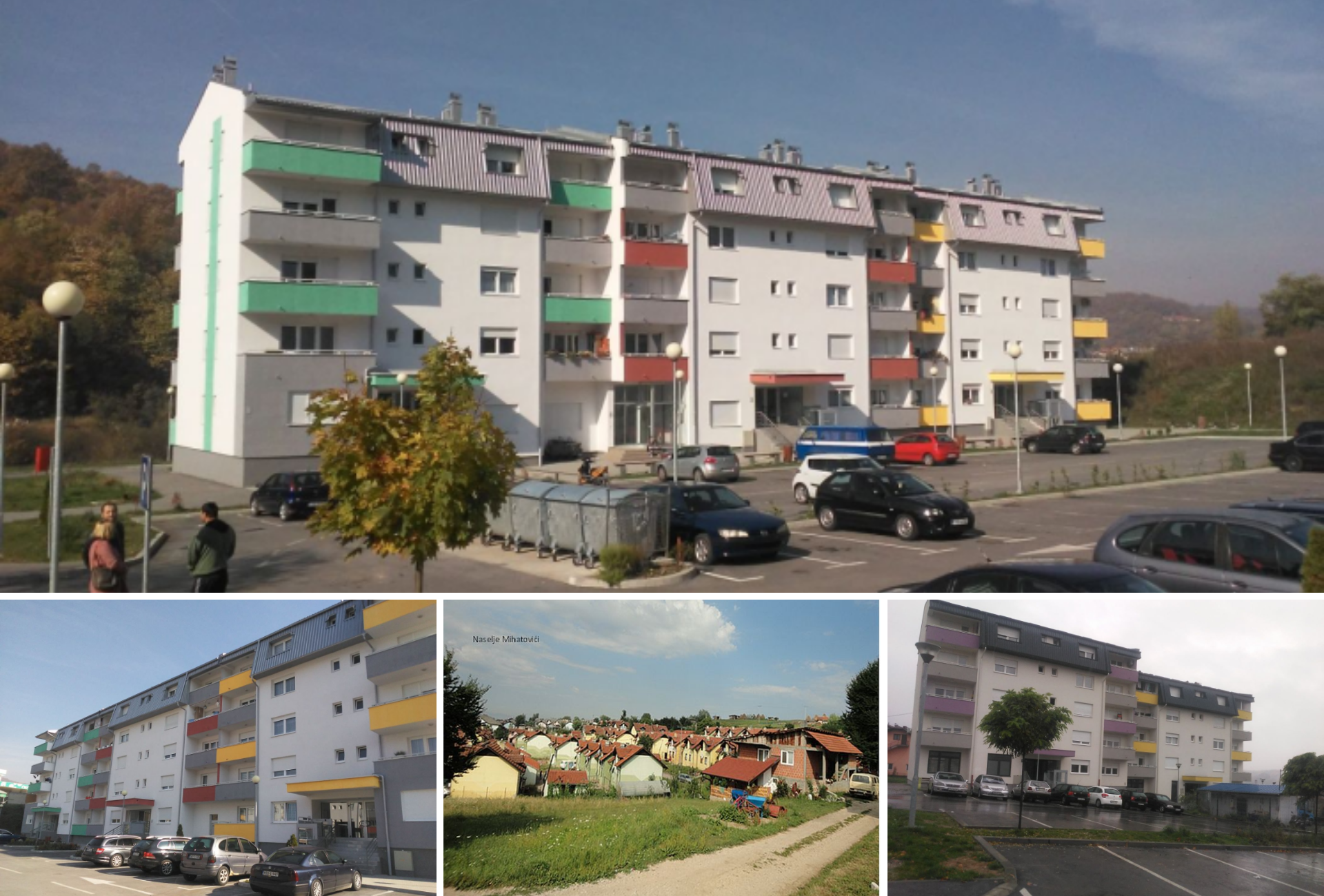
In 1996, following a mass influx, the City of Tuzla built a settlement of about 220 housing units for persons in need or that have been displaced. Created with the help of the Norwegian People’s Aid, the settlement gradually fell into disrepair until it was closed in 2021. It was supposed to be a temporary solution given the war or early post-war circumstances. There was a dire need for a better solution for the families living in inhumane conditions.
Bosnia and Herzegovina did not have a regulated field of social housing. The City of Tuzla first became familiar with non-profit social housing through the implementation of a project in cooperation with the humanitarian organization Hilswerk Austria, when 22 housing units were built in two locations, SI Selo and Kiseljak.
Non-profit-social housing is the organised provision of housing of a certain standard to families that for various, primarily economic, social, and other reasons, are not able to solve their housing problem independently. This was the driving motive for drafting the document “Non-Profit Social Housing Strategy”. In 2015, the City of Tuzla appointed a Working Team that, with the expert assistance of the Catholic Relief Services (CRS), initiated and drafted the NSS Strategy Draft Document, which was adopted by the City Council in 2016.
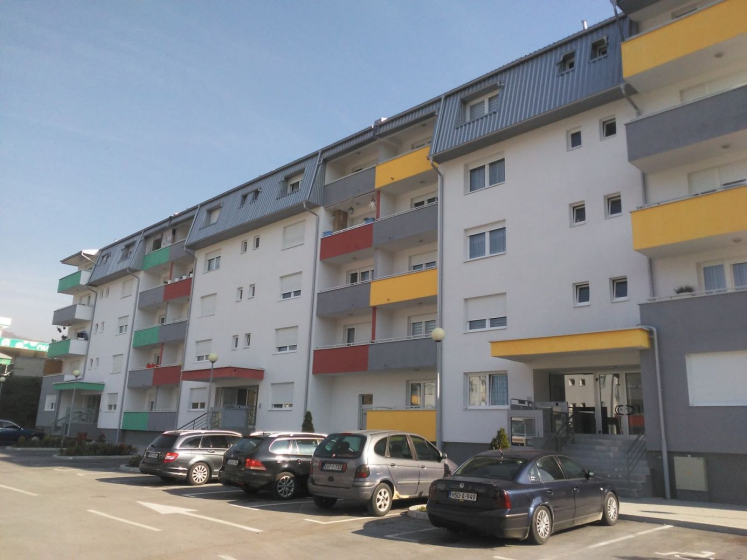
Accordingly, in the following period, the City of Tuzla signed an agreement for two projects with the support of the Council of Europe Development Bank (CEB) and the Regional Housing Programme (RSP) for the construction of 156 apartments, under the CEB II Project, and 54 apartments under the RSP Project, which is a total of 210 housing units.
What is innovative about this project?
Innovation was created through the very model of social housing, where housing in collective housing units is brought closer to people who have been unable to access adequate and affordable housing. A significant number of tenants were unemployed and financially vulnerable, but with the subsidy provided by the City of Tuzla and Tuzla Canton, they manage to pay the expenses arising from the use of housing units.
The City of Tuzla managed to provide social and economic assistance to several families who have moved into these buildings by supporting them with the purchase of beekeeping equipment, chainsaws, excavators, computers, as well as professional training and additional training for individual users.
Together with CRS, the City developed projects for economic support and decent housing for the beneficiaries of all projects. The necessary preconditions for integration were created so that families now feel responsible for the property of the city.
Most tenants find employment by accepting jobs that they can do with their education degree, and by expressing their needs for social protection and the use of social rights.
Apart from Tuzla, the CEB II Project and the RSP Project have been implemented in other municipalities of both the Canton and the Federation. These projects have proven to be valuable and efficient, with a possibility of implementation in other areas and with other municipalities and cities.
Interventions
The activities were carried out through various meetings, assignments, and special teams and commissions. In accordance with activities defined by The UN Refugee Agency (UNHCR), the Ministry of Human Rights and Refugees (MHRR), and CRS, the City of Tuzla conducted a survey among potential beneficiaries, collected the necessary documentation, and prepared files for each potential beneficiary, which were then evaluated by the Identification Commission and the Verification Commission. Actions, such as workshops and statements served to inform potential tenants of their rights and obligations. Moreover, before the tenants moved in, the City of Tuzla established a legal framework.
Impact
Further implementation of projects has brought benefits to the local communities in which the buildings were built, in the form of additional space provided for an ambulance, trade activities, administrative activities, and a nursery.
- Tenants use new apartments with central heating, and a donation in the form of house appliances is provided for all tenants.
- Tenants who have no income or are social welfare beneficiaries are provided with funds from the Tuzla Canton and the City of Tuzla;
- The City of Tuzla owns 236 apartments that are used for non-profit and social housing;
- The key success factor is the socio-economic inclusion of displaced persons, quality integration in the local community, and housing services for persons displaced and in need.
State, federal and cantonal levels of government have provided funds for the construction of residential and commercial buildings, as well as new projects for other cities.
Lessons learned
- Relevant focus on a specific target group of displaced people.
- Project implementation from scratch to build an affordable housing mechanism and a legal framework for the sustainable social housing system at the local level.
- Economic support and decent housing are provided for the beneficiaries of all projects.
- Implementation of a rental subsidy system.
- Broad scope of applicability and focus on socioeconomically most vulnerable people.
- Setting up a social housing complete framework: definition of eligibility criteria and the measures for financial support with the provision of social housing in the City of Tuzla.