This project was a finalist in the European Responsible Housing Awards 2022 under the ‘Leaders of Innovation, agents of fair energy transition’, organised by Housing Europe, the International Union of Tenants and DELPHIS.
Organisation: Siloge
Goals
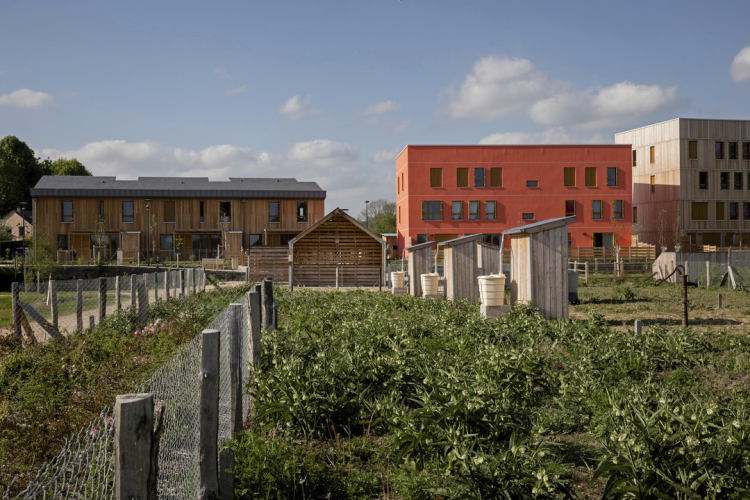
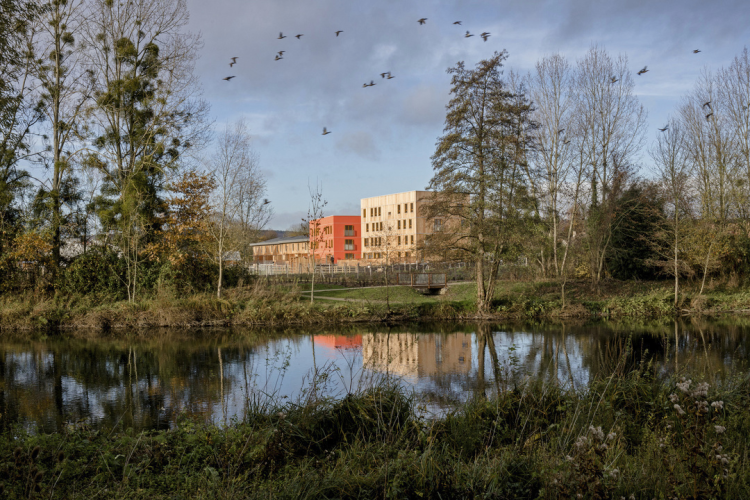
The eco-Village des Noés is part of the desire for more sustainable urban development. This project consists of 98 passive housing, various services, and facilities. These buildings are spread over three villages located on 4.6 hectares (ha), of which 1.5 ha is a green belt on which construction is not possible and are part of the urban development of the riverbanks of the Eure and the surroundings nearby which will eventually lead to the construction of an Eco-quartier of nearly 300 housing units, infrastructure, and equipment on 35 ha.
Context
Located south of Rouen, a few kilometres from Louviers, Val de Reuil is the most recent of the nine “new towns” planned by Paul Delouvrier in the early 1970s and built entirely on bare lands. The development of the “seed village” [a village, where a group of farmers are involved in production of seeds of various crops and cater to their own needs] never met the objectives of the original plans, and the expansion of the town stopped before reaching the riverbanks of the Eure. The dynamics of the expansion of the town was brought again on the agenda for several years and led to prioritising the junction and integration of the banks of the Eure and the station into the town centre. This eco-village project in Val de Reuil was born from the desire to offer the inhabitants a new way of living that is more respectful of the planet and in line with their aspirations. The idea is to rely on the past experience of the village’s social life, rather than on its urban form, as well as on its economic foundation: agriculture.
Thanks to the dynamism of the municipality, more than 60,000m² of industrial park has been built in recent years. The jobs generated, mainly in the pharmaceutical sectors, create a need for diversified housing. In addition, the municipality has been involved in eco-responsible development for several years.
The building of new housing units has been thought out in such a way as not to create any disruption between the new buildings and the pre-existing ones which were mainly houses
A particularly sensitive site from an ecological point of view, with 2 ha that were in risk of flooding, was transformed into an actual asset in the project, by converting it into a unique market gardening and plant complex.
The functioning of the neighbourhood will be based on its social and intergenerational mix. In terms of energy, the City of Val de Reuil and SILOGE want to make this ecovillage an exemplary neighbourhood.
What is innovative about this project?
The Noés programme, deployed around three villages, includes zero-energy low-passive housing units for rental housing and shared equity low energy buildings ; a hall with an organic store and a laundry for common use; a municipal nursery; organic family gardens and an organic farm supporting social reintegration; the creation of a pike spawning ground; attentive flood management; local compost management; a heating network; car-sharing vehicles.
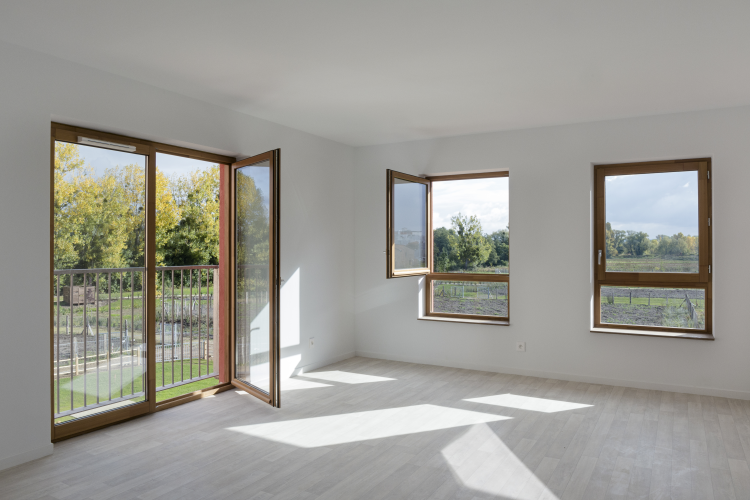
Each unit has an outdoor area, wooden shutters, green roofs, and photovoltaic panels.
Initiatives to promote the respect for biodiversity were implemented: an association provides two donkeys as part of the Asinobus (school bus service), beehives were installed in the conservatory orchard, a bird observatory is available by the river, and a shared chicken coop is also maintained by the inhabitants. All the characteristics of the EcoVillage of Noés allow it to take into consideration the application for the prestigious World Wide Fund for Nature label: One Planet Living.
Interventions
The inhabitants were questioned as part of a sociological survey. Information meetings were held.
Impact
The Eco-Village des Noés and the way it has taken into consideration the surroundings of water and nature, as well as the shared governance model have turned it into a living lab that could be an inspiration for similar future development projects.
Lessons learned
- Holistic sustainable approach.
- Innovative scalability, given that 80% of social housing is concentrated in big cities.
- Good combination of social housing and environmental protection.
- Innovative project a “testing ground for future living.”
- Innovative solution for creating sustainable communities.