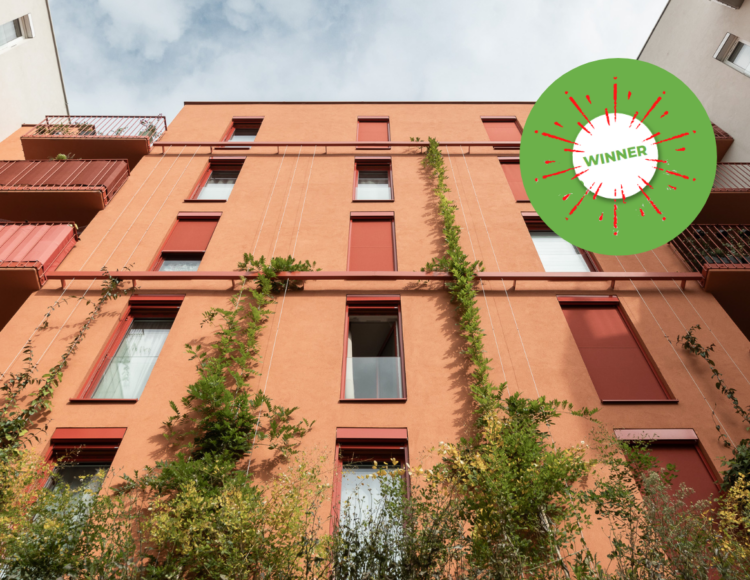
This project was a winner in the European Responsible Housing Awards 2025 under the ‘Agents of fair energy transition’, organised by Housing Europe, the International Union of Tenants and DELPHIS.
Organisation: WBV-GPA
Goals
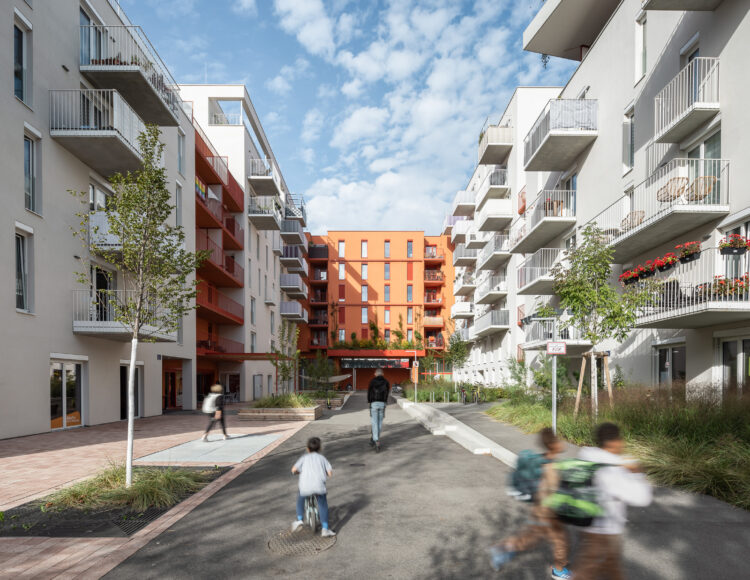
Completed between October 2020 and November 2022, the Wientalterrasse project set out to demonstrate that large-scale, climate-responsible housing can be realized in a socially inclusive and affordable way. The project delivered 295 subsidized apartments—196 standard and 99 SMART units—for a broad and diverse group of residents including families, single/separated parents, seniors, youth in care, and people with special needs. Beyond eliminating fossil fuel use and lowering operational costs through a fully renewable energy supply, the project prioritized social cohesion through shared community spaces and support services, while advancing circular economy practices through on-site reuse and repair infrastructure.
Context
Vienna, while committed to ambitious climate and housing affordability goals, faced a rising population and increasing housing costs. Existing housing stock often relied on conventional heating and lacked inclusive or intergenerational design. The Wientalterrasse development, located in the 14th district (Penzing), addressed these challenges by integrating sustainability, social diversity, and cost control in one comprehensive housing model.
The project was supported by the City of Vienna’s funding schemes for subsidised and SMART housing and complied with the city’s climate goals by ensuring the complete phase-out of fossil fuels. It aimed to model a replicable, fossil-free housing solution that was not only technically advanced but also socially responsive.
What is innovative about this project?
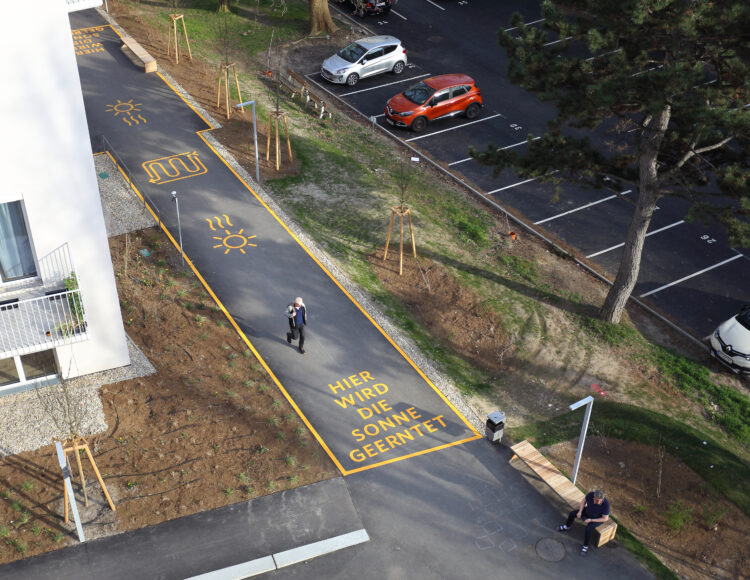
Wientalterrasse is one of the first large-scale housing projects in Vienna to combine a fully fossil-free energy supply with inclusive housing design and on-site circular economy practices. Technically, the complex is powered by an integrated system of 64 deep geothermal probes, unglazed solar absorbers, and a wastewater heat recovery system. These are connected through thermally activated building elements that provide both heating and cooling across all units year-round.
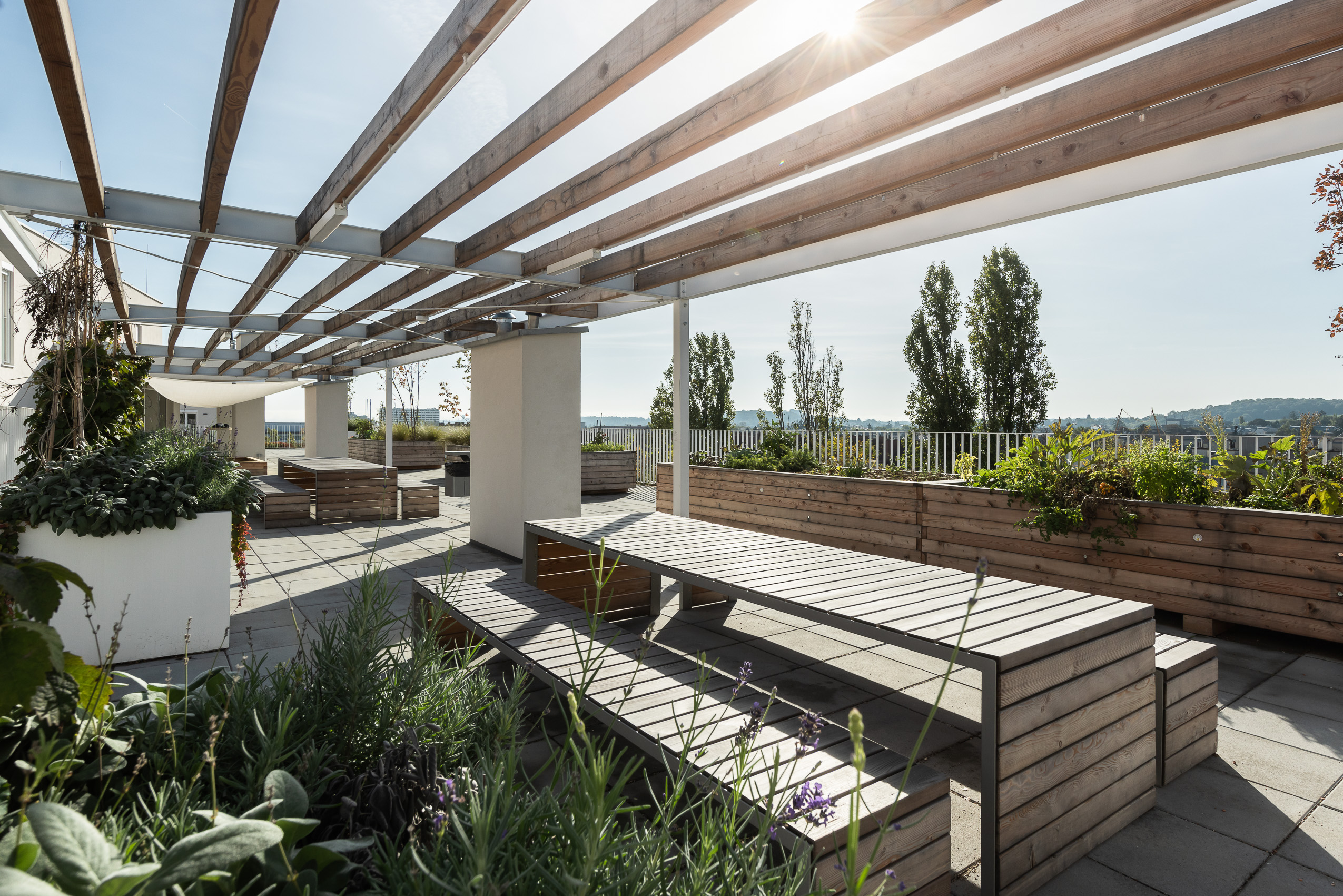
Social innovation is equally central. The project offers specialised housing units and shared amenities that encourage intergenerational and community living. Facilities include KLUB+ All in Penzing—a generation centre operated by Kuratorium Wiener Pensionisten-Wohnhäuser (KWP)—community terraces, and meeting rooms for resident interaction.
A notable feature is the on-site repair and reuse workshop operated by R.U.S.Z (Reparatur- und Service-Zentrum), a pioneer in the Austrian circular economy sector. The facility allows residents to repair household items, reducing waste and fostering a culture of sustainability within the housing complex.
Interventions
The Wientalterrasse project was realized through extensive collaboration among public institutions, technical experts, and social organizations:
- The ‘City of Vienna’ aligned strategic planning, regulatory requirements, and subsidies to support affordability and sustainability.
- Architectural firms ARGE KDG (Christoph Lechner & Partner, Berger+Parkkinen Architekten) partnered with WBV-GPA to ensure ecological performance, social functionality, and aesthetic integration.
- The ‘Austrian Institute of Technology (AIT)’ conducted dynamic energy flow simulations to fine-tune the efficiency of the geothermal, solar, and wastewater recovery systems.
- ‘KWP (Kuratorium Wiener Pensionisten-Wohnhäuser)’ provided expertise for intergenerational facilities and programming.
- ‘R.U.S.Z’ implemented the repair workshop and promoted reuse practices as part of the site’s long-term sustainability framework.
- Social support services such as ‘Verein Balance’ and ‘MA 11’ (Vienna Youth and Family Welfare Office) contributed to the inclusive housing typologies and resident support programming.
These tools and collaborations were coordinated through a shared commitment to delivering a replicable and forward-looking model for climate-aligned, inclusive urban living.
Impact
- Delivered 295 subsidized apartments for a diverse range of resident groups
- Achieved 100% fossil-free energy supply via integrated renewable systems
- Maintained affordable rents (€7.95/m² standard, €7.50/m² SMART) through energy-efficient operations
- Certified to klimaaktiv GOLD and ÖGNB standards for ecological and energy performance
- Established a generation center and shared amenities to promote intergenerational living
- Reduced environmental impact through an on-site repair workshop managed by R.U.S.Z
- Demonstrated successful collaboration between city authorities, technical experts, and social service organizations
- Set a replicable standard for cost-effective, inclusive, and climate-aligned urban housing
- Created a replicable urban development model balancing cost, inclusion, and climate goals
Lessons learned
- The project combines affordability, sustainability, and social inclusion in an exemplary way.
- With its fossil-free energy concept and focus on diverse resident needs, the project demonstrates how housing can address climate goals while fostering community.
- The low rents, thoughtful communal facilities, and replicable design set a strong example for future developments.