Across Europe, the post-war social housing stock is confronting a familiar set of challenges: ageing buildings, energy poverty, declining public spaces, and the need to strengthen community cohesion while accelerating renovation efforts. Our Horizon Europe project drOp set out to demonstrate how these challenges can be tackled at neighbourhood scale, combining social innovation, digital tools and local economic development within a single, replicable methodology.
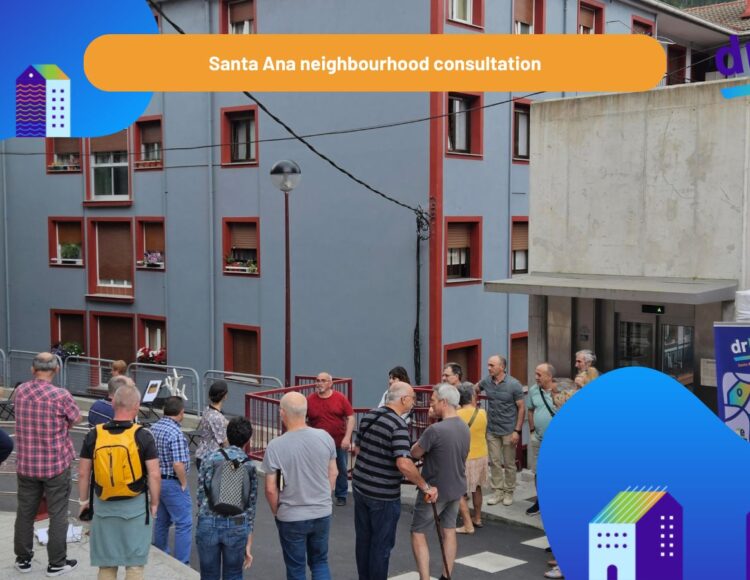
The project’s real-world laboratory was Santa Ana, a 1960s neighbourhood in Ermua (Spain). Here, rapid industrial growth once drove population expansion, but the district still struggles with accessibility barriers, a lack of quality public space, low energy performance and a long-standing sense of being overlooked. drOp responded by creating and testing an Integrated Renovation Methodology (IRM) — a structured but flexible process that starts not with technical upgrades, but with listening, co-creation and shared ownership.
Over three years, the municipality and residents developed a comprehensive neighbourhood diagnosis, a 2035 vision, and a set of co-designed actions. Some were strategic, others very hands-on: a Neighbourhood Office offering advice on renovation, digital services and energy bills; an Energy Community connecting households, a school and local businesses around shared solar production; a Mapathon that used geolocalised digital tools to identify obstacles and opportunities; and a series of tactical urbanism pilots that temporarily transformed streets and squares to test new layouts. drOp also invested in people through a certified training course on energy-efficient construction, opening pathways to local employment.
Together, these initiatives helped rebuild trust, strengthen participation and create visible improvements that residents could relate to — a crucial achievement in areas where scepticism toward public initiatives is understandable. The impact did not go unnoticed: Ermua was selected among Spain’s “50+ Disruptors”, earning national recognition for innovation in public administration.
Beyond Ermua, drOp placed strong emphasis on peer learning. The cities of Elva (Estonia) and Matera (Italy) tested the methodology in their own contexts, each with distinct challenges and strengths. Elva applied the IRM to a Soviet-era housing district, leveraging Estonia’s digital culture to engage residents and design a long-term strategic plan. Matera, shaped by its cultural and creative heritage, explored how community networks can support neighbourhood transformation, even amid political changes. These rich contrasts helped refine the methodology and proved its adaptability across Europe’s varied housing landscapes.
The project’s most tangible legacy is the Replication Roadmap — a practical guide synthesising the full learning cycle: diagnosis, co-governance, stakeholder mapping, quick-win actions, long-term planning, financing considerations and evaluation. It distils three years of experimentation, successes, challenges and feedback into a structured method that other cities can adopt and tailor to their needs. The roadmap is accompanied by a suite of open resources, including templates, training materials, guidance reports and the final evaluation of the IRM’s performance.
drOp ultimately shows that neighbourhood renovation becomes more effective and more resilient when social and economic value are integrated alongside technical improvements; when residents are active shapers of the process; and when local institutions are equipped with the tools and confidence to lead long-term transformation.
All methodologies, reports and tools — including the Replication Roadmap — are publicly available and ready to support cities embarking on their own fair, inclusive and community-driven neighbourhood renewal: drOp Results pack.