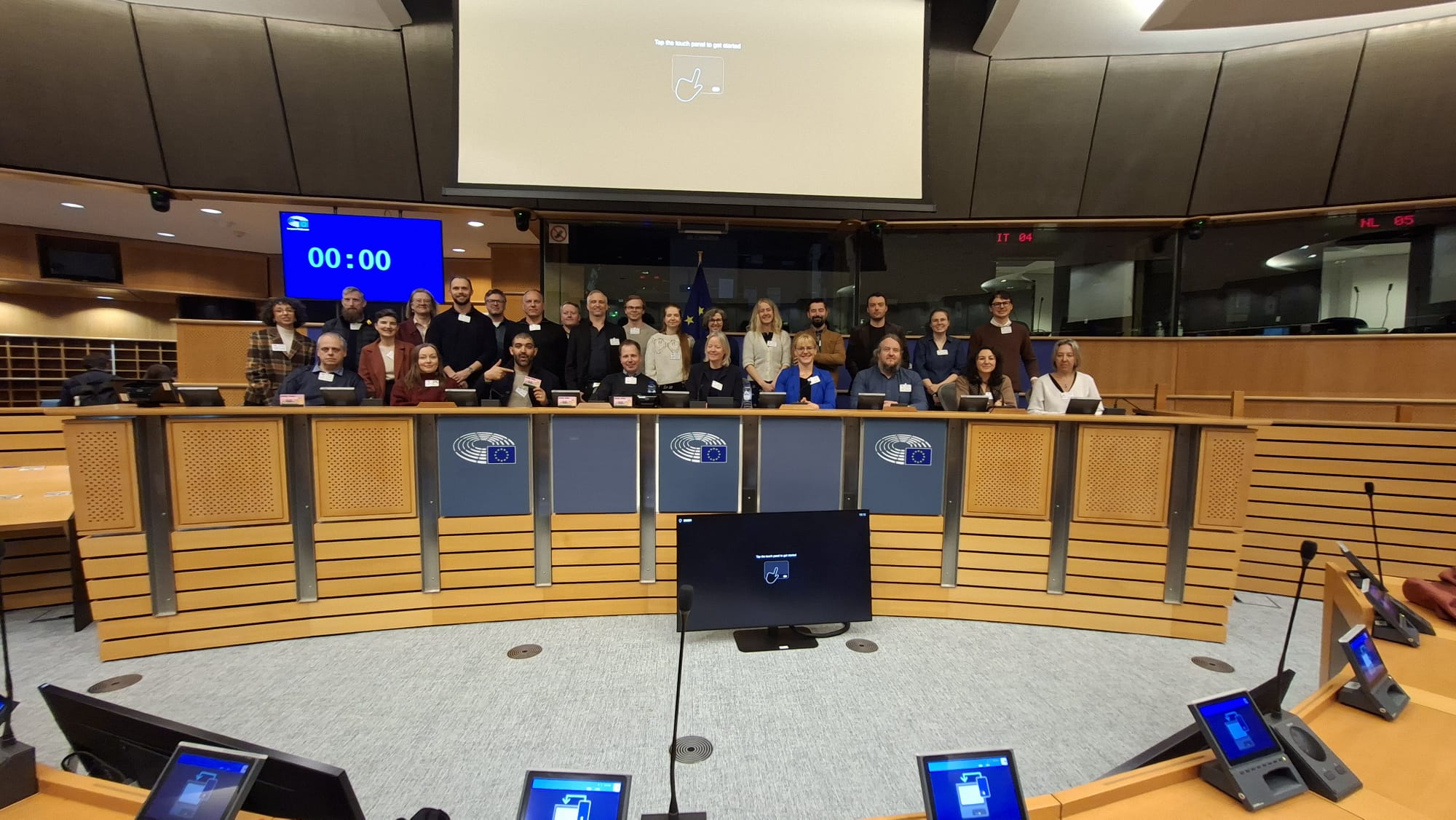
In the middle of a housing shortage and a climate transition, how much land and money should still be reserved for parked cars? This is the question that Housing Europe and our EU-funded project, SHARE-North Squared put on the table at the European Parliament on March 5, 2026.
Everywhere in Europe, millions of square metres of valuable urban land remain reserved for storing private cars. Research presented by Lund University put the scale into perspective. Europe has around 41 million regulated parking spaces and another 190 million unregulated ones. A car is used only a small fraction of the day while every trip starts and ends in a parking spot. Each of those spots comes with a price. Surface parking can cost €3,000 to €5,000 to build, but multi-storey or underground parking can easily reach €10,000 to €20,000 or more per space. These costs rarely appear as a separate line on a bill. Instead, they are quietly embedded in rents, house prices, and the cost of goods and services. In practice, people without cars often subsidise those who have them.
That matters for housing. Minimum parking requirements in planning rules frequently force developers to build parking whether residents need it or not.
The result is less land for homes, lower housing density, and higher construction costs.
In a deep housing crisis, legislation is still mandating expensive parking and embedding those costs into “affordable” housing.
For our host, MEP Marcos Ros Sempere, the choice facing cities is between one model that is expensive and car-dependent and another that pairs cleaner mobility with housing that people can actually afford. Moving towards a better model means aligning legislation, planning tools, and funding rather than treating housing and transport as separate debates.
Some cities are already moving.
In Bremen, the shift from parking to mobility is already happening in practice. The German city of around 575,000 inhabitants has more than 30,000 car-sharing users and was the first in Germany to introduce a car-sharing station in the public street space. Despite still having roughly 435 cars per 1,000 inhabitants, the city has begun to rethink how parking rules shape urban development. According to Cornelia Cordes from the Freie Hansestadt Bremen, the city has introduced innovative parking bylaws that shift the focus from parking provision to mobility management. Instead of simply mandating parking spaces, the rules allow developers to contribute financially to the city, with those funds reinvested into sustainable mobility. The approach is gaining public support and surveys show that 54% of residents consider the policy good or very good.
A recent development by the public housing company GEWOBA illustrates the shift. Instead of building the 156 parking spaces normally required, the project built just 30 underground spaces. The €441,000 saved went into cargo bikes, car sharing services and bicycle infrastructure.
Elsewhere, cities are experimenting with shared mobility directly targeted at social tenants.
In Mechelen, the Flemish city that even won a prize to be the bike capital of Flanders, social housing residents can access shared bikes with a 50% discount and receive travel credits for shared cars. Community workers help residents get used to the services. The aim is to cut traffic while keeping mobility accessible.
Housing providers easily see the economic logic.
The Flemish social housing company Woonland estimates that one shared car can replace five underground parking spaces in a development. With underground parking costing roughly €30,000 per space, that can translate into savings of about €120,000 per project. At the same time, regulations still often require parking construction rather than allowing housing providers to invest those funds into shared mobility systems.
Björn Berggren from Public Housing Sweden argued that Europe needs to move from a model built around access to parking towards one centred on access to mobility. The current system often hides the true cost of parking infrastructure. In Sweden, tenants typically pay only about 25% of the real cost of parking spaces. The remaining costs are absorbed elsewhere, often through housing budgets. The result is a cross-subsidy that is rarely acknowledged. Only around half of residents in Swedish public housing own a car, meaning that those without one are effectively paying for parking infrastructure they do not use. Berggren argued that charging the real cost of parking would help rebalance the system, reduce unnecessary infrastructure and allow housing providers to invest more efficiently in mobility solutions that serve all residents rather than a minority of drivers.
Brussels is starting to connect the dots.
Constantin Heitzer from European Commission’s DG CLIMA pointed to the role of the new emissions trading system for buildings and road transport, ETS2. The collected revenues are expected to accelerate zero-emission mobility while supporting building renovation and heating upgrades with the aim being to cut CO₂ emissions while easing pressure on household budgets.
National Social Climate Plans, now being submitted by EU countries, are designed to support vulnerable households through investments in housing and mobility.
Work is also underway to strengthen cooperation across sectors. Edit Lakatos from the Commission’s Housing Task Force in DG ENER said a stakeholder working group will be created under the pan-European investment platform to enable structured exchanges between public authorities, financial actors and housing providers. Part of the ambition is also that the recast of the Energy Performance of Buildings Directive and the new EU agenda for cities aim to better connect housing policy with urban and energy planning. Cities may also gain access to new funding streams under the proposed next Multiannual Financial Framework.
Meanwhile, the Commission is preparing a housing simplification package for 2027 to identify barriers slowing down housing projects. For Mariangiola Fabbri also from the Housing Task Force in DG ENER, bringing vacant buildings back into use and upgrading existing stock allows cities to rely on infrastructure that is already in place.
Finally, the first European Affordable Housing Plan has also recognised that transport costs and access to mobility directly shape housing affordability.
The broader point was that housing policy does not operate in isolation.
For Sorcha Edwards, Secretary General of Housing Europe, the challenge requires systems thinking. Housing, mobility and finance should reinforce social goals rather than undermine them. Investments in healthier transport systems often generate wider returns. She quoted Rob Hopkins, co-founder of the Transition Network, who stresses that €1m invested in cycling infrastructure can generate €38m, far larger savings for health systems. Limited-profit housing models in Austria have shown similar public benefits.
Tenant representatives made another point, represented by Emiliano Rocchetti by the International Union of Tenants (IUT), said that decarbonising transport should not mean pushing housing further away from jobs and services. Homes need to be well-connected to daily life, otherwise, the cost of transport simply replaces the cost of housing.